Advanced padel drills
The best advanced padel drills train decisions, not just strokes: which exit to choose off the glass, when to follow a drive in, when to poach and how to keep pressure on one opponent. Below are nine drills for strong club and tournament players, each with a court diagram, a pass mark and a way to make it harder.
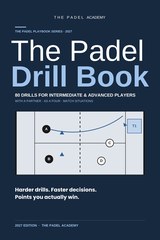
All nine drills are adapted from The Padel Drill Book: Intermediate & Advanced, our 80-drill book for levels 3 to 6. The code after each name is its number in the book.
What makes a drill advanced
By level 4 you can already hit a bandeja, play off the back glass and hold a rally at the net. What separates you from the next level is rarely a missing shot. It is choosing the wrong one, choosing it late, or moving in a different direction from your partner. So these advanced padel drills give you a read before every ball: where the opponent is standing, how high the rebound comes out, whether the return is weak enough to attack.
- Feed like a match. The feeder should vary height, pace and timing. If you can predict every feed, you are rehearsing a stroke rather than practising a choice.
- Keep score. Every drill has a pass mark. Write it down and repeat the drill until you hit it twice in a row.
- Finish with points. Most drills below end in live play. LTA Padel also points to match play and competition as the way to practise in-match scenarios.
- Levels are on the book's 0–7 scale. Our padel levels guide explains how the common scales compare.
Advanced padel drills off the glass
1. Three-door corner (G4 in the book)
Players: 2 · Time: 15 min · Level: 4–6
Set-up: You start on the right, a couple of metres off the back glass. The feeder stands on the far service line. Mark three targets: deep cross-court, short cross-court and deep through the middle.
How it works: The feeder sends a firm ball into your side glass so it runs on into the back glass. While it is coming off the second wall, the feeder steps in to the net, stays on the service line or drops back. Glance up once, then choose: a lob over a net player, a chiquita at the feet of someone on the service line, or a firm drive into the deep middle against a player at the back.
Pass mark: Nine good decisions out of twelve, with at least seven landing in the right target.
Make it harder: The feeder waits until the ball is almost on your racket before moving, or adds a fake step.
2. High rebound, hard choice (G5)
Players: 3 · Time: 15 min · Level: 4–6
Set-up: You start at the net on the right. The feeder lobs from the far back court. A third player, C, waits diagonally opposite at the far net, acting as an opponent who lobbed and then came forward.
How it works: The lobs vary, so some come off your back glass high and others at waist height or lower. Turn, run back beside the side glass and let each one rebound. Say "hit" or "lob" out loud as the ball meets the glass. If it comes out around shoulder height, hit a bajada downwards, either deep cross-court or into C's feet. If it is lower, lob over C. C plays the reply and the point runs for two more shots.
Pass mark: Eight correct calls in ten, and not one bajada played from below the waist.
Make it harder: C is allowed to intercept a soft bajada, and the feeder mixes in quick, low lobs that tempt you but should not be attacked.
3. Off your own wall (G6)
Players: 2 · Time: 12 min · Level: 4–6
Set-up: You stand on the right, about two metres from the back glass. The feeder works from the far service line and aims deep and fast at your corner.
How it works: Some feeds are reachable and you play them normally. Others skid past you. For those, turn your back to the net, get the racket under the ball and hit upwards into your own back glass, roughly two metres up, so it loops back over you and falls on the far side. Go for height, not speed. The rules allow this because hitting your own glass is legal, but if the ball touches your own mesh you lose the point (FIP Rules 13 and 14), so aim high on the glass and away from the corner.
Pass mark: Four of six escapes land in on each side, with no escape played on a ball you could have reached normally.
Make it harder: The feeder goes off the side glass first, and a net player waits to volley any weak escape.
Overhead and transition drills
4. Gancho over the middle (O5)
Players: 3–4 · Time: 12 min · Level: 5–6
Set-up: You (A, right side) and your partner (B, left) are at the net. The feeder lobs from the far baseline. Mark a deep middle target and a cross-court corner target.
How it works: The feeder lobs over the centre line, just on your backhand side and too high to volley. Your partner calls "yours" the moment it is struck. Adjust with small steps to keep the ball up over the left side of your head, then reach up with a straight arm and hook over the top of the ball, deep through the middle or cross-court. Both of you then step back up level at the net. Coaches at The Padel School and Padel Browser describe the gancho the same way: a high, straight-arm overhead for lobs over your non-hitting shoulder, mostly played from the right side. Left-handers playing the left side do the mirror image.
Pass mark: Six of eight ganchos deep in a target, each followed by a recovery to the net.
Make it harder: Mix in lobs to your forehand side, so you choose gancho or bandeja, and let C play the ball back live.
5. When to follow the drive (T8)
Players: 4–5 · Time: 15 min · Level: 4–6
Set-up: You start on the right, a step behind the service line, with your partner level with you on the left. C and D hold the net. A feeder behind them sends you balls that bounce between knee and hip height.
How it works: Hit a flat, low drive at the feet or hip of one of the net players, then watch its height over the net. If it drops below the tape and they have to volley upwards, you and your partner move in together. If it crosses high, they can hit down, so hold your ground or drop a step and split.
Pass mark: You only advance behind low drives, and you win at least six of ten rallies.
Make it harder: The net pair may reply with a chiquita at your feet while you advance.
Serve, poach and formation drills
6. Poach the return (S6)
Players: 4 · Time: 15 min · Level: 5–6
Set-up: You serve from the right box. Your partner, at the net on the left, gives a hidden hand signal before each point: poach or stay. C receives and D waits at the net.
How it works: Serve down the middle or at the receiver's body, so there is no wide angle to return into. On a poach call, your partner leaves only when C begins the forward swing, then punches the volley at D's feet or into the gap between C and D. You move straight towards the left half after the serve to cover the space your partner left. On a stay call, play normally. C never sees the signal, so every return is a real choice.
Pass mark: Win six of ten poach points, with the server in the empty space every time.
Make it harder: The net player may fake the poach, starting across and then stepping back.
7. The Australian serve pattern (P5)
Players: 4 · Time: 15 min · Level: 5–6
Set-up: You serve from the right. Your partner takes the net on your own half, shifted slightly towards the side wall to leave a lane for the serve. This is legal: the serve has to go diagonally, but the rules let the server's partner stand anywhere on their own side (FIP Rule 3). A serve that hits your partner is a fault (Rule 7), so check the spot every point.
How it works: Serve towards the centre line, then move diagonally forward to the left half. C's usual cross-court return now runs straight into your partner. If C goes down the line instead, you take it and play deep cross-court or lob. Serve ten points, then your partner serves ten.
Pass mark: Win at least six of your ten serving points.
Make it harder: Play a whole set in which the net player signals the formation, using it on half the serves at most.
Pressure games for advanced players
8. Pick a target (P8)
Players: 4 · Time: 15 min · Level: 4–6
Set-up: Normal two against two from a serve. Before each game your pair quietly picks one opponent as the target. Cones along the far centre line mark the halves.
How it works: Every ball goes into the target's half. Once per point you may play a free ball to the other player, best saved for when the target's partner has drifted over to help. Win a point with your free ball and it is worth two; the target's own errors are also worth two; all other points count once. Change height, pace and depth constantly so the target never finds a rhythm.
Pass mark: Win three of four games, with at least six points from the target's errors.
Make it harder: No free ball at all.
9. Condition cards (M8)
Players: 4 · Time: 20 min · Level: 4–6
Set-up: Write about a dozen cards, each with one condition: every return is a lob, the first volley goes through the middle, the only overhead allowed is the bandeja, and so on.
How it works: Before each game, both pairs draw a card and keep it hidden. Play normal scoring; breaking your own condition gives the point away. When the game ends, each pair tries to name the other's card, and a right guess earns a bonus point. Play six games and add games won to correct guesses.
Pass mark: Win three games without giving away a single point for breaking your condition.
Make it harder: Draw two cards per game and keep both.
A 60-minute advanced padel training session
For a pair or a four with one hour of court time, this session moves from the glass to the net and ends under pressure.
| Minutes | Block | Drill |
|---|---|---|
| 0–10 | Warm-up: mini-rallies, volleys, a few lobs and overheads | Free rally |
| 10–22 | Rebound reading and shot choice | High rebound, hard choice (G5) |
| 22–34 | Overhead on the backhand side | Gancho over the middle (O5) |
| 34–47 | Serving pair working together | Poach the return (S6) |
| 47–60 | Pressure game | Pick a target (P8) |
With only two players, swap in Three-door corner and Off your own wall, which need just a hitter and a feeder.
Common mistakes in high-level padel training
- Grooving instead of choosing. If you know what the next ball will be, the drill has become a warm-up. Ask the feeder to mix it up.
- Deciding too early. Many reads, like the rebound height or the opponent's position, only become clear at the last moment. Look late, then commit.
- Splitting at the wrong time. Land your split step as the opponent strikes the ball, as The Padel School teaches, not after.
- One player moving. Poaches, formations and advances only work when both partners move on the same cue.
For the tactical background behind these drills, read our intermediate tactics guide, and pair this page with our padel smash drills for more overhead work.
These 9 drills are adapted from The Padel Drill Book: Intermediate & Advanced. The book has 80 drills, each with its own court diagram, plus sixteen ready-made sessions and three 8-week training plans for levels 3 to 6. See the book and look inside the first 20 pages.
Frequently asked questions
What are the best padel drills for advanced players?
Drills that force a decision under match pace: exits off two walls, rebounds you must judge before attacking, poaches and serving formations, and games with a scoring twist. Fed repetition still has its place for fixing technique.
How often should advanced players train?
There is no single right number. The 8-week plans in the drill book use two sessions a week, one longer and one shorter, alongside normal match play.
Is the Australian formation legal in padel?
Yes. The serve must go diagonally into the receiver's box, but FIP Rule 3 lets the server's partner, like the receiver's, stand anywhere on their own side. Just make sure the serve cannot hit your partner, because that is a fault.
What level do I need for these drills?
They are written for levels 4 to 6 on the book's 0–7 scale: players who already have a reliable bandeja, volley and back-glass game. If that is not you yet, start with our intermediate drills.