The best padel drills for every level
The best padel drills are short, scored exercises that copy a real moment of the point: a rally off the glass, a volley at the feet, a deep bandeja, a decision about who takes the middle. Below are ten of them, from solo wall work to four-player games, each with a court diagram, the level it suits, a pass mark and one way to make it harder.
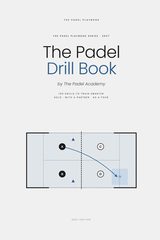
All ten drills are adapted from The Padel Drill Book, our collection of 100 drills for solo, partner and four-player practice. We have shortened and rewritten them for the web; the book has the full version of each one.
How to use these padel training drills
A drill only works if it trains something specific and you know whether you passed. Three habits make the difference between a drill and a casual hit.
- Train at your level, and a notch above it. Each drill below shows a level range on the 0–7 scale used in the book, where 0 is a first-timer and most club players sit around 2 to 4. Other systems differ; our guide to padel levels compares them.
- Keep score. Every drill has a pass mark. Write your number down and try to beat it next time. The LTA's own training tips are built the same way, around simple counting games that reward consistency.
- Stop when the quality drops. Two drills done well beat five done in a hurry. When the targets stop landing, rest or move on.
The drills use a few letters: A and B are you and your partner, C and D are the opponents, and F is a feeder with a basket of balls. T1 and T2 are target zones; a towel or racket cover makes a good marker.
Solo padel drills
1. Forehand wall rally
Players: 1 · Time: 10 min · Level: 1–3
Set-up: On an empty court, stand side-on roughly four metres from your back glass on the forehand side.
How it works: Drop a ball and play a gentle forehand into the glass at about waist height. Let the rebound bounce once, then hit again, aiming at the same patch of glass each time. Play two-minute sets with half a minute of rest, and restart with a drop when the rally breaks.
Pass mark: A rally of 20 inside two minutes, then 40.
Progression: Mix soft and medium-paced balls and keep the rally going. If the ball keeps jamming you, take a step back.
2. Rapid-fire volley wall
Players: 1 · Time: 10 min · Level: 2–5
Set-up: Stand two metres from the back glass, racket up in front of your chest.
How it works: Volley the ball into the glass and back without a bounce. There is no time for a backswing, so keep it to a short block and let the racket face do the work. Do ten forehands, ten backhands, then alternate. Five sets of 45 seconds with 15 seconds of rest.
Pass mark: 30 volleys in a row inside one 45-second set.
Progression: Move in to 1.5 metres so the exchanges get faster.
Partner padel drills for all levels
3. Bandeja depth
Players: 2 · Time: 15 min · Level: 2–4
Set-up: A starts at the net. F stands at the far back of the court and lobs balls that would drop around A's service line. T1 is the last three metres in front of F's back glass.
How it works: A turns sideways, shuffles back with the free hand pointing at the ball and plays a flat, sliced bandeja, meeting the ball in front of the head. The ball should travel low over the net and land in T1, reaching the glass without much height. Twenty balls, then swap.
Pass mark: 12 of 20 bandejas in T1.
Progression: After every bandeja, A must get back to the net before the next lob. Our bandeja guide covers the technique step by step.
4. Let it bounce or take it
Players: 2 · Time: 12 min · Level: 2–5
Set-up: A at the net, F at the far back with 20 balls.
How it works: F sends lobs of mixed length in random order. Before each ball reaches its highest point, A shouts "take" or "glass". Take means an overhead in the air (bandeja or víbora). Glass means A turns, lets the ball bounce and come off the back wall, and plays it from there. Two sets of 20.
Pass mark: 15 sensible calls out of 20, judged by F.
Progression: F adds higher, spinning lobs that are harder to read. The habit you are building: decide while the ball is still rising, because a deep lob is often easier off the glass than in the air.
5. Víbora with spin
Players: 2 · Time: 15 min · Level: 3–6
Set-up: F lobs to A from the far side, slightly shorter than for the bandeja drill. T1 sits in the opponents' far corner, cross-court from A, next to the side glass.
How it works: A meets the ball in front and a little further out to the side than for a bandeja, with a quicker forearm, brushing around the outside of the ball. The side spin makes it bounce in T1, kick into the side glass and stay low. Fifteen balls. If the ball is behind the service line when you hit it, play a bandeja instead.
Pass mark: The book counts víboras that come off the side glass below waist height. Note your number and beat it next session.
Progression: F mixes in deeper lobs, so A has to choose between bandeja and víbora on every ball.
Drills for three players
6. Volley to the feet
Players: 3 · Time: 12 min · Level: 2–5
Set-up: A stands two and a half metres from the net. C starts on the service line on the other side and walks forward as each ball is fed. F feeds chest-high balls to A.
How it works: With the racket head up and the face slightly open, A pushes the volley downwards and a little short, so it lands at C's feet. It is a placement shot, not a power shot: a short follow-through is enough. Fifteen balls, then everyone rotates.
Pass mark: 9 of 15 volleys in T1, the zone just in front of C.
Progression: C returns every ball, so the volley exchange keeps going until someone misses.
7. Chiquita control
Players: 3 · Time: 12 min · Level: 3–5
Set-up: A stands around the service line. C waits three metres from the net on the far side. F feeds medium-paced balls to A. T1 is the two-metre strip just over the net.
How it works: A slows the racket down and plays a soft, low ball with an open face that drops into T1. C has to come forward and volley it upwards. After each chiquita, A takes two steps towards the net, exactly as in a match. Rotate after 15 balls.
Pass mark: 9 of 15 chiquitas that C can only volley up. If C can hit down, it was too high.
Progression: C volleys back and the point is played out.
Four-player drills
8. Who takes the middle volley
Players: 4 · Time: 12 min · Level: 2–5
Set-up: Your pair (A and B) at the net, the opponents (C and D) at the back. Before you start, agree a rule: usually whoever has the forehand in the middle plays it, unless the partner is clearly closer or the ball is coming diagonally towards them.
How it works: C and D aim every drive between A and B. One of them calls "mine" the moment the ball leaves the opponent's racket, not when it arrives. Play the point out and rotate pairs every seven points.
Pass mark: No middle balls lost to hesitation in a game.
Progression: C and D may also go down the line, to punish a pair that crowds the middle. Our positioning guide explains the common middle-ball agreements.
9. Net vs back points
Players: 4 · Time: 15 min · Level: 2–5
Set-up: The net pair (A and B) starts close to the net; C and D start at the back. The back pair starts each point with a lob.
How it works: Play the point out normally. The net pair earns one point for every rally they win. The back pair earns two if they win the rally while still at the back, and one if they win it after taking the net. First to 11, then swap roles.
Pass mark: Win the game from either end.
Progression: The net pair is not allowed to smash, so they have to keep the net with control. The lesson for the back pair: lob first, then fight for the net, rather than trying to drive past two volleyers.
10. Three-shot pattern
Players: 4 · Time: 15 min · Level: 3–5
Set-up: Net pair A and B against C and D at the back, normal points.
How it works: The net pair must play two deep balls through the middle before they are allowed to attack. From the third ball on they can go for an angle, the feet or a bandeja into the side glass. Attacking too early costs the point, even if the shot wins. Count your shots out loud at first. Play to 11, then swap.
Pass mark: 6 of 11 points won using the pattern.
Progression: Raise the number of deep balls before the attack to five.
The best padel drills for your level
| Your level (book scale) | Start with | Then add |
|---|---|---|
| 1–2: rallies, first volleys | Forehand wall rally | Bandeja depth, Who takes the middle volley |
| 3–4: club regular | Let it bounce or take it | Volley to the feet, Net vs back points |
| 4–6: strong club and above | Víbora with spin | Chiquita control, Three-shot pattern |
If you are newer to the game, our padel drills for beginners start one step earlier, with co-operative rallies and soft volleys.
Drills to improve padel fast: a 60-minute session
The book plans every hour the same way: ten minutes of warm-up, twenty on technique, twenty on a pattern that links two or three shots, and ten on a scoring game. Here is that structure for a four, using the drills above.
| Minutes | Block | Drill |
|---|---|---|
| 0–10 | Warm-up | Easy movement, then mini-padel at the net |
| 10–30 | Technique | Volley to the feet (rotate every 15 balls), then Bandeja depth on both halves |
| 30–50 | Pattern | Who takes the middle volley |
| 50–60 | Game | Three-shot pattern to 11 |
On your own, swap the first two blocks for the wall rally and the volley wall. Repeat the same focus for a few weeks before you change it, so your scores tell you whether you are improving.
These 10 drills are adapted from The Padel Drill Book. The book has 100 drills, each with its own court diagram, plus four 4-week training plans, from beginner to advanced, and a session log. See the book and look inside the first 20 pages.
Common mistakes with padel drills
- Hitting too hard. Padel rewards control and placement more than pace. If the targets stop landing, slow the ball down until they do.
- No score. Without a number you can't tell whether a drill is working. Write it down every time.
- Bad feeding. For technique drills the feeder should send the same ball again and again, from where the real shot would come from. Feeding is a skill in its own right.
- Smashing everything. Most overheads in padel are about keeping the net, not finishing. Train the bandeja before the smash.
- Too many drills. Three or four per session is plenty. Spend the time on repetitions, not on explaining new rules.
Frequently asked questions
What are the best padel drills?
The best drills match the part of your game that loses you points. For most club players that means the back glass, volleying deep and deciding who takes the middle. A good all-round mix is a wall rally, Bandeja depth, Who takes the middle volley and a scoring game such as the Three-shot pattern.
Can I do padel drills on my own?
Yes. Wall rallies and the volley wall need only a court and a few balls. Our solo padel drills have more ideas, from home exercises to serve targets.
How often should I do padel drills?
As often as you can fit in alongside matches. The Padel Drill Book suggests one structured drill session for every three matches, which is realistic for most club players and enough to notice progress.
How long should a padel drill session be?
An hour works well: ten minutes of warm-up, forty minutes of drills and ten minutes of a scoring game. Each individual drill usually runs for 8 to 15 minutes.
How many balls do I need for padel drills?
A basket of 30 to 50 balls is ideal for feeding drills, and old balls are fine for that. Use fresh balls for the game at the end of the session.