Padel bandeja drills
Good padel bandeja drills train the whole job of the shot: turning early, sending the ball deep with slice and getting back to the net before the reply. The eight drills below take you from a bandeja aimed at a called lane to choosing between bandeja and smash, and to covering the counter-lob with your partner.
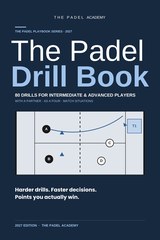
All eight are adapted from The Padel Drill Book: Intermediate & Advanced, mostly from its overhead chapter. The code after each name is its number in the book.
What a good bandeja does
The bandeja is the answer to the lob when you are at the net. LTA Padel calls it the antidote to the lob: a controlled overhead with slice that lets you keep your place at the net, sent deep so it stays low off the glass. It rarely wins the point. It wins the position. So every drill below scores two things: where the ball lands, and whether you are back at the net in time.
The technique checkpoints come from mainstream coaching and from our own bandeja guide:
- Turn side-on early and move with side steps or crossovers, never backpedalling square to the net.
- Racket up, contact in front of you and to the side, at around head height. Use the continental grip.
- Slice, not power. Swing forward and across the back of the ball. Padel Browser and LTA Padel both stress placement and spin over pace.
- Recover forward. Use the momentum of the shot to step back to the net, level with your partner.
How to practise the bandeja: direction and footwork
1. Three-lane bandeja call (O1 in the book)
Players: 2–3 · Time: 12 min · Level: 3–5
Set-up: You are at the net on the right. The feeder has a basket on the far baseline. Cones divide the opponents' back third into three lanes: left, middle and right.
How it works: The feeder lobs a medium ball over your forehand side and calls a lane as it peaks. Turn, take two or three small steps back and play a sliced bandeja that lands past their service line in that lane. Step forward to the net and split before the next feed. Once the early calls are easy, the feeder calls later, just before your forward swing.
Pass mark: Nine of twelve deep in the called lane, back at the net every time.
Make it harder: Put two players in the outer lanes; any bandeja that drops short, they can attack, either on the volley or after the glass.
2. Back, strike, forward (O2)
Players: 2 · Time: 12 min · Level: 3–5
Set-up: You start at the net on the right. One cone sits a metre behind your service line, another at your net position.
How it works: The feeder lobs high and deep, so the ball comes down around your service line or just behind it. Turn your shoulders before your feet move, then shuffle or cross over back to the rear cone with the ball in front of your hitting shoulder. Play a deep cross-court bandeja with your weight travelling towards the net, so the swing flows straight into your first step back in. Sprint to the net cone and split as the next lob is struck. If a lob is too deep to get behind, let it go to the glass.
Pass mark: Six of eight sequences with a deep bandeja and a split at the net cone in time.
Make it harder: The feeder mixes deep and short lobs and drives at you once you reach the net.
3. Late-call overhead (O9)
Players: 2 · Time: 15 min · Level: 4–6
Set-up: You at the net on the right, the feeder at the far baseline. Mark three zones: deep middle (bandeja), cross-court corner (víbora) and open court (smash).
How it works: The feeder lobs a ball where all three overheads are possible. Turn, racket up, free arm pointing at the ball. When your preparation is complete, the feeder calls "bandeja", "víbora" or "smash" and you play that shot into its zone. You learn to keep the same set-up for every overhead, which makes your shot hard to read.
Pass mark: Twenty of twenty-seven correct shots in the matching zone.
Make it harder: The feeder may also call "leave", and you turn, let it go by and play it once it comes off the back glass.
Padel bandeja drills with a decision
4. Por tres or bandeja (O6)
Players: 3–5 · Time: 15 min · Level: 5–6
Set-up: You at the net on the right, your partner on the left. A cone marks your service line. A target near the opponents' side glass, towards the back, is for the por tres.
How it works: The feeder mixes short, high lobs with deeper, flatter ones. If you get under the ball inside your service line and balanced, smash it por tres. If the lob pushes you behind the line or comes in low and quick, play a deep bandeja and keep the net. After each ball the feeder marks two things: right or wrong choice, in or out.
Pass mark: Ten right choices in twelve.
Make it harder: Two players defend live. Our smash drills cover the por tres in detail.
5. Mine, switch or glass (P6)
Players: 3 · Time: 12 min · Level: 4–6
Set-up: You and your partner at the net, about two and a half metres back. The feeder stands at the far back glass, diagonal to your partner.
How it works: The feeder lobs cross-court over your partner, changing height and depth. Before the ball peaks, your partner calls one word. "Mine": they back up and play a deep bandeja. "Switch": you cross behind and play it while they move to your side. "Glass": both drop back and the ball is played after the glass. The feeder then sends a second ball straight away, aimed low at the player now on the right-hand side, and you both need to be level by then.
Pass mark: Eight in ten: a correct call made before the ball peaks, and both of you level when the second ball arrives.
Make it harder: The feeder adds lobs down the centre, which either player could own.
6. Give up the net together (T3)
Players: 4 · Time: 15 min · Level: 3–5
Set-up: Your pair holds the net. C and D stand at the back with a basket and open every rally by lobbing over one of you or down the middle.
How it works: This drill teaches the other half of the bandeja decision: when not to play one. Whoever the lob beats shouts "back" the instant it is out of reach. You both retreat together, keeping your spacing, and whoever is on the ball's side takes it off the glass. C and D move in behind their lob and the point is played out.
Pass mark: Seven of eight lobs where you retreat as a pair and land the first defensive shot.
Make it harder: C and D mix in shorter lobs that must be played as a bandeja, so the call is a real choice.
Bandeja exercises: games and pair cover
7. Cover the counter-lob together (O10)
Players: 4–5 · Time: 15 min · Level: 4–6
Set-up: You and your partner at the net. The feeder lobs the first ball. C waits near the far back glass, ready to lob back; D may join.
How it works: You send a deep bandeja or víbora towards C and step forward again at once. C lobs back over either of you or down the centre. Whoever it is flying over makes the call, "mine" or "switch", before it peaks. "Mine" means that player retreats for the overhead; "switch" means the partner cuts across behind on a diagonal and plays it, while the lobbed player moves over to the empty side. Play the next ball live.
Pass mark: Six of eight sequences finish with one of you on each side and the next ball controlled.
Make it harder: C can choose a low drive instead of a lob, so nobody moves until the shot is read.
8. Earn the smash (M2)
Players: 4 · Time: 15 min · Level: 4–6
Set-up: You and your partner start at the net. The opponents begin behind their service line and open every point by lobbing.
How it works: Play normal points, but count every bandeja your pair plays, out loud. After the third, smashes are allowed for the rest of the rally. A smash before that loses the point, even if it was a winner. Play to eleven, then swap.
Pass mark: Win a game to eleven without a single early smash.
Make it harder: Four bandejas earn the smash, and any bandeja landing short of the service line doesn't count.
A 60-minute bandeja session
| Minutes | Block | Drill |
|---|---|---|
| 0–10 | Warm-up: volleys, then easy lobs and shadow bandejas | See our warm-up guide |
| 10–22 | Footwork under the deep lob | Back, strike, forward (O2) |
| 22–34 | Direction from a stable position | Three-lane bandeja call (O1) |
| 34–45 | Pair cover after the overhead | Cover the counter-lob together (O10) |
| 45–60 | Pressure game | Earn the smash (M2) |
Swap hitter and feeder often. Tired shoulders let the contact point drift behind you, and the bandeja drops short.
Common bandeja mistakes
- Hitting it hard and flat. Without slice the ball bounces up off the back glass and gets punished.
- Backpedalling facing the net. The ball ends up behind your head. Turn first, then move.
- Opening the chest early. It costs depth and shows the opponents where the ball is going.
- Admiring the shot. Even a deep bandeja is wasted when the reply finds you stuck behind your service line.
- Aiming short. A soft ball into mid-court sits up for a counter-attack.
When the bandeja is reliable, the next step is its attacking version. Our padel víbora drills build on it.
These 8 drills are adapted from The Padel Drill Book: Intermediate & Advanced. The book has 80 drills, each with its own court diagram, plus sixteen ready-made sessions and three 8-week training plans. See the book and look inside the first 20 pages.
Frequently asked questions
What is the best drill for the bandeja?
A fed lob followed by a recovery to the net, repeated until the footwork is automatic. Back, strike, forward does exactly that. Once it is solid, add direction with the three-lane drill.
Where should a bandeja land?
Deep, past the opponents' service line and towards their back glass, so the ball comes off the glass low. A short bandeja gives them an easy attack.
Should I smash or play a bandeja?
Smash only when you are under the ball, balanced and close to the net. If the lob pushes you back or arrives low and quick, the bandeja is the safer shot because it keeps you at the net.
How can I practise the bandeja without a feeder?
It is hard to train properly alone, because the shot depends on reading a lob. With a partner, take turns feeding from a basket and swap every ten overheads.
Is the bandeja the same as the víbora?
No. Both are controlled overheads, but the víbora is faster, with side spin, and aims to keep the ball low off the side glass. Most coaches teach the bandeja first.