Padel drills for coaches
The best padel drills for coaches are ones you can feed consistently, score honestly and turn into a live game in the same session. This page gives you a padel coaching session plan, feeding tips, a simple way to organise your own drill library and ten drills: five from The Padel Drill Book and five from The Padel Drill Book: Intermediate & Advanced, each marked with the book it comes from.
Drills 1–5 are adapted from The Padel Drill Book (100 drills, all levels). Drills 6–10 are adapted from The Padel Drill Book: Intermediate & Advanced (80 drills, levels 3–6). All are rewritten and shortened for the web.
How to run a padel coaching session
Most good padel sessions follow the same arc: one theme, a repeated shot, a choice added to it, live play and finally a score. The Padel School describes the same cycle for improving: choose one area, repeat it, add a little variation once it feels comfortable, then test it in a match. The LTA's own drill suggestions follow the pattern too: ladder rallies with a rising target, fed back-glass balls, and a scoring game that punishes errors.
- One theme per session. Glass, net, overheads or pair movement. Mixing three themes gives three short starts and no depth.
- Feed from the real spot. Stand where the opponent would play the shot from: net position for volleys, deep in the far court for lobs.
- Same ball first, then vary one thing. For technique, repeat the same height, speed and spin. Once the player copes, change height, depth or pace, but only one at a time.
- Hand feeds for beginners, racket feeds after. A racket feed carries the pace and spin players have to read in a match.
- One cue per set. Say it before the feed, not during the shot.
- Every drill has a pass mark. A number tells you when to make it harder and gives players a reason to concentrate.
Padel coaching session plan (60 minutes)
This plan suits four players and a coach on one court, at roughly level 3 to 4. It uses drills from both books, described in full below.
| Minutes | Block | Drills | Book |
|---|---|---|---|
| 0–10 | Warm-up | Movement, then quick-hands volley duel | Drill Book |
| 10–25 | Technique | Cross-court rally on both diagonals, then volley clock | Both |
| 25–45 | Pattern | The invisible rope, then only the lob that passes | Both |
| 45–60 | Game | Net or nothing, first to 7 | Intermediate & Advanced |
For a longer booking, The Padel Drill Book: Intermediate & Advanced lays out a 75-minute session that fits inside 90 minutes of court time: warm-up, a read block, a choice block, a short reset, a pressure game, then a cool-down and review.
Padel drills for coaches from The Padel Drill Book
1. Cross-court rally
Players: 2 · Time: 12 minutes · Level: 1–4 · Source: The Padel Drill Book
Set-up: Two players about a metre in front of their back glass, on opposite diagonals. Mark a deep zone on each side, two to five metres from the glass.
How it works: Rally diagonally so each ball lands in the zone and clears the net by about a metre to a metre and a half. If a ball beats you, play it off the glass. Switch diagonals after four minutes. Keep the pace moderate until the pair can string 20 balls together.
Pass mark: A rally of 15 in the targets. Harder: balls outside the target count as out.
2. Quick-hands volley duel
Players: 2 · Time: 8 minutes · Level: 2–5 · Source: The Padel Drill Book
Set-up: Two players facing each other across the net, about two metres back.
How it works: First co-operate: volleys at chest height and medium pace without a bounce. Then compete: volleys only, aimed at body or feet, and lobs are banned. Four sets of 90 seconds. Coaching cue: racket up in front of the chest between every ball.
Pass mark: Thirty co-operative volleys in a row, then points to 7. Harder: start 1.5 metres from the net.
3. The invisible rope
Players: 2 plus a feeder · Time: 10 minutes · Level: 2–4 · Source: The Padel Drill Book
Set-up: A pair at the net about four metres apart. The first time, tie a rope or towel between them. The feeder works along the far side of the net.
How it works: The feeder walks across and points the racket at one player. The pair shifts together: whoever is closer to the ball guards the line while the partner slides towards the middle, not just sideways. Then remove the rope and add fed volleys. Three sets of two minutes. If one player moves and the other doesn't, the rope goes slack, which is a very visual cue for players.
Pass mark: No balls through the middle in two minutes. Harder: fast feeds aimed at the gap.
4. Who takes the middle volley
Players: 4 · Time: 12 minutes · Level: 2–5 · Source: The Padel Drill Book
Set-up: One pair at the net, one at the back. Agree the rule first: middle balls belong to whoever has the forehand there, unless the ball comes cross-court and the diagonal player is closer.
How it works: The back pair drives every ball into the middle zone. The net player who takes it calls "mine" the moment the opponent strikes. Play the point out; rotate pairs every seven points.
Pass mark: No middle balls lost to hesitation. Harder: the back pair may go down the line to punish a pair that over-covers the middle.
5. Reflex wall at the net
Players: 4 · Time: 8 minutes · Level: 3–6 · Source: The Padel Drill Book
Set-up: All four players at the net, two to three metres back.
How it works: Ten co-operative volleys in any direction, then the point goes live: volleys only, aimed low, no lobs. Play to 5, then switch partners. Short punches win these exchanges; big backswings lose them.
Pass mark: First pair to 5. Harder: go live on the fifth volley.
Drills from The Padel Drill Book: Intermediate & Advanced
These drills add a decision to the shot: a late call, an opponent's position or a condition on movement. They suit level 3 and above.
6. Volley clock (N1 in the book)
Players: 2 · Time: 12 minutes · Level: 3–5 · Source: Intermediate & Advanced
Set-up: The volleyer at the net on the right; the feeder just inside the far service line. Four cones as targets: two deep, two short.
How it works: The feeder plays medium-paced balls at hip-to-chest height and shouts a number as each feed is struck. The player split-steps, listens and volleys to that cone, then recovers. Twenty feeds a set. In set two, call when the ball is halfway; in set three, as it crosses the net. The drill trains one compact volley shape where only the racket face changes.
Pass mark: Fourteen of 20 on target in set three. Easier: call before the feed and use two targets.
7. Call the drop (G1 in the book)
Players: 2 · Time: 12 minutes · Level: 3–5 · Source: Intermediate & Advanced
Set-up: The player on the service line, right side. The feeder two to three metres from the net on the far side. Three cones at one, two and three metres from the back glass.
How it works: The feeder varies pace and height. The player turns side-on as the ball crosses the net and, before it touches the glass, calls the cone at which it will have fallen to hip height. Then they move there and play cross-court into a target. Twelve balls, then change sides. A call after the rebound counts as wrong: the point is to read, not react.
Pass mark: Per side, nine right calls and nine clean returns from 12. Harder: add side spin and an occasional feed into the corner.
8. Three-lane bandeja call (O1 in the book)
Players: 2–3 · Time: 12 minutes · Level: 3–5 · Source: Intermediate & Advanced
Set-up: The player at the net on the right; the feeder at the far baseline. Cones divide the far back third into left, middle and right lanes.
How it works: The feeder lobs over the player's forehand side and, at the top of the lob, calls a lane. The player stays sideways, takes a few small steps back and slices a bandeja beyond the service line into that lane, then steps back in to the net and splits. Sets of 12; later, call just before the swing. Opening the chest early gives the direction away and costs depth.
Pass mark: Nine of 12 deep in the called lane. Easier: two lanes, called before the feed.
9. Only the lob that passes (T1 in the book)
Players: 4 · Time: 15 minutes · Level: 3–5 · Source: Intermediate & Advanced
Set-up: One pair at the back, about 1.5 metres from the glass; the other at the net with a basket, starting each rally with a medium volley.
How it works: The back pair lobs. If the lob gets past the net player and makes them turn, both move forward together, splitting each time the opponents hit. If the lob is short or reachable, they stay back and defend. Play the point out: two points for a rally won after advancing behind a good lob, one for any other. Watch for players who start moving before the lob has even peaked.
Pass mark: In 12 rallies, move up behind six or more lobs and never behind a short one. Easier: the net pair lets every lob pass.
10. Net or nothing (M6 in the book)
Players: 4 · Time: 15 minutes · Level: 3–6 · Source: Intermediate & Advanced
Set-up: Normal doubles from a serve. A spare player, or the players themselves, judges where the winners stood.
How it works: Play normal points. When a point ends, it only counts if both players of the winning pair are in front of their service line. Otherwise nobody scores, and that includes errors by the opponents. First to 7 counted points; play three games and change ends after each.
Pass mark: Win two of the three games. Easier: one player in front of the line is enough.
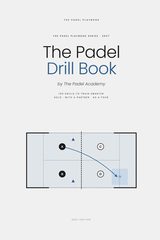
Drills 1–5 are adapted from The Padel Drill Book. The book has 100 drills, each with its own court diagram, plus a 60-minute session template, feeding guidance and four four-week training plans. See the book and look inside the first 20 pages.
Drills 6–10 are adapted from The Padel Drill Book: Intermediate & Advanced. The book has 80 drills, each with its own court diagram, plus two ready-made sessions per chapter, three eight-week plans and a level self-test. See the book and look inside the first 20 pages.
Building a padel drill library
A drill library is only useful if you can find the right drill in 30 seconds on court. Tag every drill the same way:
- The moment of the point. Glass, net, overheads, transitions, defence, serve and return, pair patterns or games. The Intermediate & Advanced book is organised exactly this way, with a letter per chapter.
- Level range. Use one scale for everyone. Our padel levels guide explains the common scales.
- Players and time. Solo, two, three, four or six-plus, and how long the drill runs.
- The pass mark. The score that tells you to make it harder, plus one way up and one way down.
- The game it leads to. Every technique drill should point to a scoring game that rewards the same shot.
Keep a simple log of each player's scores. The trend over four sessions tells you more than any single result. For ready-made sets, our drills for 4 players and intermediate drills pages are good starting points.
Padel drills PDF
If you want something to take on court, our free padel drills page offers a one-page printable PDF with ten drills from The Padel Drill Book, each with a diagram, a coaching cue and a score target. Leave your email and the download starts straight away. The Padel Drill Book is on sale now; The Padel Drill Book: Intermediate & Advanced is out too, and you can flip through its first 20 pages before you buy.
Common coaching mistakes
- Talking too much. One cue per set. Players learn from touches, not speeches.
- Feeding at the wrong pace. Too fast trains panic, too slow trains waiting. Leave the gap a real rally would leave.
- Too many drills. Two drills done well beat six rushed ones. End a drill when the quality falls away, whatever the clock says.
- No live ball. A session that never goes live leaves players unable to use the shot in a match.
- Players waiting. Rotate roles (worker, feeder, scorer) so everyone is busy.
Frequently asked questions
What drills should a padel coach use?
Drills you can feed consistently and score: cross-court rallies, fed back-glass exits, volley and bandeja targets, pair movement drills and conditioned games. Add a decision, such as a late call, once the shot is stable.
How do you structure a padel coaching session?
Warm-up, then a technique block on one shot, a pattern block that links it to the next ball, and a scoring game with a condition that rewards the same shot. In 60 minutes that is roughly 10, 20, 20 and 10 minutes.
Is there a padel drills PDF?
Yes. Our drills page has a free one-page PDF with ten drills from The Padel Drill Book, with diagrams, cues and score targets.
How do I make a padel drill harder?
Change one thing at a time: more pace, less time between feeds, a later call, a smaller target or a live opponent. When the pass mark comes easily in two separate sessions, move up.
How many players can one coach run on a court?
Most drills here are built for two to four players plus the coach feeding. With more, use rotation games and give waiting players a role such as scoring or feeding.