Padel footwork drills
Padel footwork drills train the short, sharp movements that decide most points: a split step as the opponent hits, two or three quick steps, a balanced shot and an instant recovery. The ten drills below cover each part of that chain, from the split step at the net to moving back under a lob, with a diagram and a pass mark for each.
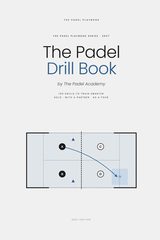
The drills are adapted from The Padel Drill Book, which has 100 drills for solo, partner and four-player sessions, including a full chapter on movement and positioning.
How to improve padel footwork
A padel court is small, so the movements are short: a few metres in any direction, stop, hit, recover. That changes what good footwork looks like. Long sprints matter less than the first step, the stop and the way back.
- Split step on time. The Padel School's advice is to land your small hop just as the opponent makes contact. Timing matters far more than height. They also suggest a lighter, quicker split step than in tennis, because there is less time to react.
- Small adjustment steps. Arrive early, set your feet, then hit. Beginners need more small steps than experienced players to stay balanced, and that is fine.
- Shuffle, don't cross. Side steps keep you facing the play. Save the crossover for a wide ball or the last step to a deep one.
- Turn before you go back. Under a lob, turn your hips first and move back sideways. Backpedalling while facing the net is how players fall.
- Recover after every shot. The shot isn't finished until you are back in position and ready for the next one. Think of it as hit, recover, split.
Split step drill padel players should start with
1. Split-step timing
Players: 2 · Time: 8 min · Level: 1–4
Set-up: A at the net with the racket up. F feeds from the other side of the net.
How it works: As F's racket meets the ball, A makes a tiny hop and lands on the balls of the feet, then pushes off towards the ball and volleys it back to F. The hop is only a couple of centimetres; a big jump is too slow. Four sets of 15 balls.
Pass mark: F judges each landing. 12 of 15 on time.
Progression: F hides the direction of the feed until the last moment. For an easier version, F announces the side first.
2. Mirror drill
Players: 2 · Time: 8 min · Level: 1–4
Set-up: Two players face each other across the net, each about two metres back. No balls needed.
How it works: The leader moves in short bursts: left, right, forward, back. The follower copies every move and tries to stay directly opposite. Watch the leader's hips rather than the feet; the hips show the direction first. Sets of 30 seconds, swapping the leader each time, six sets in all.
Pass mark: 5 of 6 sets where the follower never falls more than one step behind.
Progression: The leader shadows shots as well, and the follower copies the shot too.
Padel movement exercises at the net
3. Lateral shuffle shadow
Players: 1 · Time: 8 min · Level: 1–3
Set-up: Two cones seven metres apart, both two and a half metres from the net.
How it works: Side-step from one cone to the other without crossing your feet, and shadow a volley when you get there: forehand at one cone, backhand at the other. Keep the hips low and your head at the same height all the way across. Six sets of 30 seconds, with 30 seconds of rest.
Pass mark: 12 cone touches in 30 seconds.
Progression: Each time you pass the centre, add a split step.
4. Volley recovery step
Players: 2 · Time: 10 min · Level: 2–4
Set-up: A cone in the centre of A's half, two and a half metres from the net. A starts on it.
How it works: F feeds wide, alternating towards each side wall. A crosses over to reach the ball, volleys deep, then pushes off the outside foot and shuffles back to the cone. Hitting and recovering should feel like one movement, not two. Four sets of ten balls.
Pass mark: All four sets with A touching the cone between every ball.
Progression: F feeds the next ball as soon as A leaves the cone, not when A gets back. Our volley guide explains the deep volley you play here.
5. Closing the net
Players: 2 · Time: 12 min · Level: 3–5
Set-up: Three cones in a line at five, three and a half and two metres from the net.
How it works: F feeds three balls. A volleys the first from the back cone, moves up and volleys the second from the middle one, then finishes the third firmly into open court from the cone nearest the net. Every time F strikes the ball, split step, even on the move: stop, split, hit, then move. Eight sequences.
Pass mark: 5 of 8 sequences where all three volleys are clean and the last one wins the point.
Progression: F makes the third ball a lob, so A has to turn and go back.
Footwork at the back of the court
6. Alternating wall rally
Players: 1 · Time: 10 min · Level: 2–4
Set-up: Stand in the middle of the court, about four metres from your back glass.
How it works: Hit a forehand into one half of the glass, then a backhand into the other, and keep alternating with one bounce between shots. After each shot, shuffle back to the centre. Make a small split step as the ball meets the glass, then go. If you find yourself reaching with the arm, your feet started late. Four sets of 90 seconds, with 30 seconds of rest.
Pass mark: 16 alternating shots in a row.
Progression: Every fourth ball, step in and volley it.
7. Recovery position reset
Players: 2 · Time: 10 min · Level: 2–4
Set-up: A cone in the centre, three metres in front of the back glass. F feeds from the far side.
How it works: F sends the ball into one of A's back corners. A plays it, then gets back to the cone before the next feed, starting the recovery while the swing is still finishing. In a match you would drift slightly towards the side you hit to, not dead centre. Four sets of ten feeds.
Pass mark: 8 of 10 feeds with A already back at the cone.
Progression: F feeds immediately after A's shot, so the recovery has to be quicker.
Moving back for lobs and overheads
8. Overhead footwork ladder
Players: 1 · Time: 10 min · Level: 2–4
Set-up: A line of cones about 1.4 metres apart, from near the net back towards the service line.
How it works: Start at the net cone, ready, racket up. Turn side-on, shuffle back to the second cone and shadow a bandeja. Come forward to the net, then back to cone three and finally cone four, with a shadow swing at each. The order never changes: turn, shuffle, swing. Four sets of the whole ladder, 30 seconds of rest between them.
Pass mark: All four ladders without crossing your feet, apart from an optional crossover on the last, deepest step.
Progression: A partner lobs a real ball at the last cone.
9. Net-to-back transition
Players: 2 · Time: 10 min · Level: 2–4
Set-up: A at the net, F at the back on the far side.
How it works: F lobs over A. A turns and runs back on a diagonal rather than straight under the ball, so it stays in front and in view. If A can reach it, A plays a bandeja. If not, A lets it bounce and come off the glass, then lobs back. Three sets of eight.
Pass mark: 6 of 8 lobs dealt with under control.
Progression: F mixes drives in with the lobs, so A can't start turning early.
Moving as a pair
10. The invisible rope
Players: 2 and a feeder · Time: 10 min · Level: 2–4
Set-up: A and B at the net. The first time, hold a rope or a long towel between you so the gap is fixed. F stands on the far side.
How it works: F walks from side to side, pointing the racket at A or B. The pair moves together: the player nearer the ball covers the line, and the partner slides towards the middle, not just sideways. Then drop the rope and add fed volleys. Three sets of two minutes.
Pass mark: No balls through the middle in a two-minute set.
Progression: F feeds fast through the gap to test it. Our positioning guide explains the rope idea in a match.
A 60-minute session of padel footwork drills
- Warm-up (10 min): easy jogging and side shuffles, then Lateral shuffle shadow. Our padel warm-up has a full routine.
- Technique (20 min): Split-step timing, then the Mirror drill.
- Pattern (20 min): Net-to-back transition, then the Invisible rope with fed volleys.
- Game (10 min): play points where every split step counts. Any player caught flat-footed when the opponent hits gives away the point.
On your own, swap the partner drills for the Overhead footwork ladder and the Alternating wall rally. Footwork improves with repetition, so keep the same session for a few weeks and watch the scores climb.
These 10 drills are adapted from The Padel Drill Book. The book has 100 drills, each with its own court diagram, plus four 4-week training plans, from beginner to advanced, and a session log. See the book and look inside the first 20 pages.
Common footwork mistakes
- Splitting too early or too late. A split step that lands before or after the opponent's contact is no help. Land as they hit.
- Jumping too high. A big hop takes longer to land. Keep it small and light.
- Standing up between steps. Every time your head rises you lose speed. Stay low through the movement.
- Backpedalling under lobs. Turn first. Running backwards facing the net is slow and risky.
- Admiring the shot. Recovery belongs to the shot: begin moving back while you finish the swing.
Footwork drills sit well alongside off-court work; our padel exercises cover strength and speed for the legs.
Frequently asked questions
What is a split step in padel?
A small hop you make as your opponent hits the ball, landing on the balls of your feet. It leaves you balanced and ready to push off in any direction as soon as you see where the ball is going.
When should I split step?
Land it at the moment the opponent makes contact. Too early and you are standing still again when the ball comes; too late and you are still in the air when you need to move.
How do I improve my padel footwork quickly?
Add a split step before every opponent shot, take small steps into position, turn before moving back, and recover straight after every shot. The Split-step timing and Volley recovery step drills train all four.
Should you cross your feet in padel?
Mostly no. Side shuffles keep you facing the play and balanced. A crossover step is fine for a wide ball or the final step to a deep lob, but not as your normal way of moving.
Can I do padel footwork drills at home?
Some of them. The Lateral shuffle shadow, the Mirror drill and split-step practice need only a little space. Drills with lobs, walls and volleys need a court.