Padel games for groups
The best padel games for groups keep everyone hitting, put a score on every point and rotate players quickly so nobody stands around for long. Below are ten group games and fun drills for four to eight or more players, including king of the court, with the set-up, the scoring and how to run each one when you have more players than places on court.
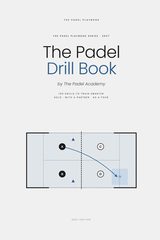
Eight of these games come from The Padel Drill Book. Two of them, Hot seat and the Pair challenge ladder, come from the Pressure Games chapter of The Padel Drill Book: Intermediate & Advanced and suit players from level 3 up. All are rewritten and shortened for the web.
How to run padel games for groups
Only four people can play on a padel court at once, so a group session lives or dies on rotation. A few habits keep it moving:
- Rotate on a rule, not a feeling. Decide before you start whether players change after every point, every game or every won rally.
- Give waiting players a job. Feeding, keeping score, judging a line or calling the lives keeps them involved and keeps the game honest.
- Keep games to 10–15 minutes. Change the format before energy drops.
- Use a basket. A feed from the side restarts play in seconds; collecting balls kills group sessions.
- Mix partners. Swapping pairs between games stops the strongest pair from running away with every format.
The LTA's training tips include a simple consistency game you can add to any of these: in a normal match, a mistake earns a yellow card, and a second mistake in the same game earns a red card and loses that game. For a full social format with rotating partners, see our guide to padel americano.
Padel drills for 6 to 8 players
1. King of the court
Players: 6+ · Time: 15 minutes · Level: 2–6
Set-up: One pair holds the king side of the court at the net. The other pairs queue on the opposite side. A feeder, or the next pair in the queue, starts every point.
How it works: The feed always goes to the challengers. Play the point out. If the challengers win, they cross to the king side and the old kings join the back of the queue. If the kings win, the next challengers step on. Kings collect a point for every point they win on the throne.
Goal: First pair to 10 king points.
Progression: To take the throne, challengers need two straight point wins. Tip for kings: be patient and make the challengers hit three good balls before you go for a winner.
2. Hot seat (M10 in the Intermediate & Advanced book)
Players: 5–7 · Time: 30 minutes · Level: 3–6
Set-up: One player takes the hot seat on the right side and stays on court for a full round. With seven players, the partner and both opponents change after every game; with five or six, everyone who was waiting comes on.
How it works: Before each game, the hot-seat player and their new partner get 20 seconds to settle who covers the middle and which serve pattern they will open with. Each game is played with golden point at deuce. The hot-seat player scores one for each game won. After six games, someone else takes the seat, and you compare totals at the end.
Goal: Win at least three of your six games.
Progression: The hot-seat player switches sides every game, playing left with some partners and right with others.
3. Pair challenge ladder (M7 in the Intermediate & Advanced book)
Players: 8+ (four or more pairs) · Time: 30 minutes · Level: 3–6
Set-up: Put the pairs in a starting order on a sheet. Each match is first to four games, with golden point at every deuce. You need a court per match, so this suits a club night with two or more courts.
How it works: Each session, a pair may challenge any pair one or two places above it. A pair that has been challenged must play that match before it can challenge anyone itself. If the challenger wins, the pairs swap places; if it loses, it has to wait for the next session before challenging that pair again. Write every result down with the date and score. The bottom pair plays the first match next time, so the ladder keeps moving.
Goal: Climb at least one rung across three sessions.
Progression: Allow challenges three rungs up, but the challenging pair begins each game 0–15 down.
Fun padel drills for groups of four
With five to eight players, run these on one court and rotate the waiting players in by point or by game.
4. Fifteen-ball rally challenge
Players: 4 · Time: 10 minutes · Level: 1–4
Set-up: Two pairs, normal positions. One ball, no basket needed.
How it works: All four rally together, counting every ball out loud. When the count reaches 15, the next ball is live and the point is played out. If the rally breaks before 15, start again from one. Keep the ball at medium height through the middle until the count is reached; speeding up at 12 or 13 out of boredom is exactly what the drill punishes.
Goal: Six rallies that reach 15 in ten minutes.
Progression: Make it 25 balls. For newer players, drop it to eight.
5. Net vs back points
Players: 4 · Time: 15 minutes · Level: 2–5
Set-up: One pair (A and B) begins at the net. The other (C and D) begins at the back and opens every point with a lob.
How it works: Play the point out with normal rules. The net pair scores one for a point won. The back pair scores two if it wins the point while still at the back, or one if it first takes the net and then wins. First to 11, then swap roles.
Goal: Win your half of the game, then compare how you scored in each role.
Progression: The net pair may not smash. Advice for the back pair: lob first and win the net, rather than trying passing shots from the glass.
6. Lob war
Players: 4 · Time: 12 minutes · Level: 2–4
Set-up: All four players start behind their own service lines.
How it works: Only lobs are allowed, and each one has to bounce behind the opponents' service line. A short lob can be answered with a bandeja, but the player hitting it must stay behind their service line. Play to 11. Height and depth matter far more than pace here: the deepest lobs win.
Goal: First pair to 11.
Progression: Lobs must land in the last three metres. For beginners, allow two bounces. Our padel lob guide covers the technique.
7. Middle-only game
Players: 4 · Time: 12 minutes · Level: 2–5
Set-up: Mark a lane about 2.8 metres wide down the centre of both halves with cones.
How it works: Any ball that bounces outside the lane loses the point for whoever hit it. The player taking a middle ball has to call it. Play to 11, then change partners. Agree your middle rule before the first point: in this game, silence always costs you.
Goal: First to 11 without a single clash.
Progression: Narrow the lane to two metres; widen it to four for beginners.
8. Target-zone points
Players: 4 · Time: 12 minutes · Level: 2–5
Set-up: Put a target in each of the opponents' back corners, T1 and T2. Towels or cones work.
How it works: Play normal points. A point won with a ball that bounced in a target counts double. Play to 15, then swap ends so both pairs aim at both corners. Aim for the corner but accept the ball that lands in the middle; safe margins still win most points.
Goal: First to 15.
Progression: Only overheads count for the double. For beginners, make the targets four metres square.
Pressure games for groups
9. Comeback game
Players: 4 · Time: 15 minutes · Level: 2–6
Set-up: A normal doubles game.
How it works: Every game starts at 0–30 against the serving pair. Play normal padel from there and rotate the serve as usual. Play a set to six games. Treat the next point as the most important one and play it at about 80%, rather than chasing the deficit with risky winners.
Goal: Count the games each pair wins from 0–30 down.
Progression: Start every game at 0–40. For newer players, start at 15–30.
10. Golden point pressure
Players: 4 · Time: 15 minutes · Level: 2–6
Set-up: A normal doubles game, with every game reduced to a single golden point.
How it works: Golden point is one of the deuce scoring options in the FIP rules: one deciding point instead of advantage. As with a real golden point, the receiving pair chooses which side the serve goes to, so it picks the returner. Rotate the serve as normal. Play a set to six games, then a tie-break. Keep your usual routine on every point; breathe out before the serve and play the percentage shot.
Goal: Track how many golden points your pair wins in the set, week by week.
Progression: The losing pair of each game does a small forfeit. For newer players, play three points per game. Our padel scoring guide explains golden point, advantage and Star Point.
Eight of these games are adapted from The Padel Drill Book. The book has 100 drills, each with its own court diagram, including a full chapter of two-against-two games, plus a 60-minute session template and four four-week training plans. See the book and look inside the first 20 pages. Hot seat and the Pair challenge ladder come from The Padel Drill Book: Intermediate & Advanced, which has twelve pressure games among its 80 drills.
A 60-minute session for 6 to 8 players
One court, six to eight players, one basket of balls. Waiting players feed and keep score.
| Minutes | Game | How to rotate |
|---|---|---|
| 0–10 | Warm-up: mini rallies at the net | Two minutes per group of four, then swap |
| 10–20 | Fifteen-ball rally challenge | A waiting pair comes on after every live point |
| 20–35 | King of the court | Built in: losers join the queue |
| 35–47 | Lob war or middle-only game | Change one pair every game to 5 |
| 47–60 | Golden point pressure (or hot seat with five to seven players) | New pair on after every two games |
Common mistakes with group games
- Too many people waiting. If more than two pairs are off court, shorten the games or rotate after every point.
- No score. A game without a score turns into a hit-about. Even co-operative drills need a count.
- Mismatched levels. Use handicaps: the stronger pair starts behind, as in the comeback game, or must hit to targets.
- Kings chasing winners. In king of the court, patience keeps you on the throne longer than power.
- Games that run too long. Ten to fifteen minutes per format keeps the energy high.
Frequently asked questions
What is king of the court in padel?
A rotation game for six or more players. One pair holds the king side, challenger pairs queue on the other side, and the feed goes to the challengers. Challengers who win a point take over the king side; kings score for every point won on the throne.
How many players can drill on one padel court?
Four play at a time. With six to eight, use rotation games such as king of the court, or rotate waiting players in after every point or game and give them jobs such as feeding and scoring.
What are fun padel games for beginners?
The fifteen-ball rally challenge, lob war with two bounces allowed and the middle-only game with a wide lane all work from level 1 or 2, because they reward keeping the ball in play.
How do you organise padel for 8 players?
With two courts, run a pair challenge ladder or an americano. With one court, play king of the court with two pairs queueing, or rotate a new pair on after every game.
What is golden point in padel?
One deciding point at deuce instead of advantage. The receiving pair chooses which side the serve goes to. It is one of the scoring options in the FIP rules.