Padel lob drills
The most useful padel lob drills make you lob under real pressure: off the back glass, against a pair rushing the net, and as the shot that lets you take the net yourself. Below are nine drills in three groups (defensive lobs, lobs that win you the net, and dealing with the lob when you're the net pair), each with a court diagram, a pass mark and a progression.
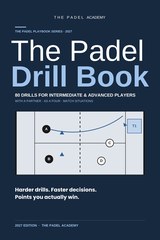
All the drills below are adapted from The Padel Drill Book: Intermediate & Advanced. We have reworded and shortened them for the web; the book has the full versions, with a court diagram for every drill.
Padel lob drills: how to run your lob practice
The lob is the shot that changes who controls a padel point. A good one sends the net pair back to their glass and gives you time to move forward. A short one hands them a free smash. That is why lob practice only works when there is a cost to the short lob: someone at the net ready to punish it.
Before you start, agree what a good lob looks like. LTA Padel's guidance matches our lob guide: open the racket face, swing from low to high with help from your legs, and land the ball beyond the opponents' service line but before their back glass. Cross-court is the safest default because it gives you the longest court to land in.
- Levels: These drills suit levels 3 to 6 on the 0–7 scale the book uses. Start with the easier version where one is given.
- Feeders: Rotate the feeder every set, so everyone lobs and everyone feeds.
- Both sides: Lob from the drive side and from the revés side. Most players are much weaker on one of them.
Defensive lob drills
1. Lob on the clock (G2 in the book)
Players: 4 · Time: 14 min · Level: 3–5
Set-up: You're at the back on the drive side. A feeder stands beside the far net post; two opponents begin on their own service line. Cones mark a cross-court target covering the final three metres of their court.
How it works: The feeder hits firmly into your back glass, and the two opponents sprint forward as the feed leaves the racket. The feeder calls "one" as the ball hits the glass and "two" a beat later. You must lob before "two", even if the contact isn't perfect, over the cross-court player and into the zone. Any lob an opponent can reach gets a bandeja, and then three more shots are played live.
The key idea: Against a pair closing the net, an early, high lob beats a late, perfect one. The half-second you wait is the half-second they use to get forward.
Pass mark: 7 of 10 lobs land in the zone without being cut off.
Make it harder: One call only, at the glass, or the opponents start a metre further forward.
2. Answer the lob with a lob (D2 in the book)
Players: 3–4 · Time: 12 min · Level: 3–5
Set-up: You and your partner start at the net, about two and a half metres back from it. The feeder, with a basket, stands close to the opposite back glass; an opponent waits on the feeder's service line.
How it works: The feeder lobs over you into the back corner. Turn and run back alongside the side wall while your partner shifts across to cover the middle. At the same moment, the opponent runs to the net. Let the lob come off the back glass, plant your feet, then counter-lob over the incoming player. If your lob gets past them, you and your partner step forward together; if it falls short, you stay back and defend.
Pass mark: 6 of 10 counter-lobs get past the incoming player and bounce within three metres of the far glass.
Make it harder: Some feeds are lower and quicker, to lure you into hurrying.
3. Every ball off a wall (G9 in the book)
Players: 4 · Time: 16 min · Level: 3–5
Set-up: Two pairs, each standing roughly two metres in front of their own back glass. There is no feeder: one player starts the rally with a deep underarm ball.
How it works: Rally together, with one condition: nobody plays a ball until it has bounced and hit the back glass. Count aloud together; a ball taken before the glass, or one that dies before reaching it, sends the count back to zero. At ten, the point goes live and either pair may attack or move forward. Winning that live point earns your pair one point. Play to seven, then change partners.
The key idea: Get depth from height, not speed. Hit it hard and it bounces back into mid-court, and the rally turns messy.
Pass mark: Five rallies in a row reach ten before you begin keeping score.
Make it harder: Once the count hits ten, whoever played ball ten has to lob, and their opponents can move up at once.
Attacking lob drills: lob, then take the net
In these four drills the lob is an attacking shot because it wins you the net. The rule in all of them: move forward only when the lob has really beaten the net player and made them turn. The Padel School lists high lobs, fast lobs and chiquitas as the shots that slow the game down enough for you to advance. Once your normal lob is reliable, you can try the lower, faster offensive lob from our lob guide in drills 4 to 6.
4. Only the lob that passes (T1 in the book)
Players: 4 · Time: 15 min · Level: 3–5
Set-up: Your pair is at the back, about a metre and a half off the glass. The opponents are at the net with a basket, and one of them opens each rally with a medium-paced volley in your direction.
How it works: Lob over a net player and try to land it near their back glass. When the lob beats them and they have to turn, you and your partner advance together, split-stepping each time they hit. If it's short or reachable, stay back and defend the overhead. A point you win after moving up behind a good lob is worth 2; every other point is worth 1.
Pass mark: In 12 rallies, your pair advances behind at least 6 lobs and never behind a short one.
Make it harder: Any lob within reach can be answered with a bandeja or víbora, and you lose 2 if you're caught moving up behind a short one.
5. Return lob over the net player (S4 in the book)
Players: 4 · Time: 12 min · Level: 3–5
Set-up: The opponent serves from the far right box and follows the serve in; the server's partner is at the net. You receive on the right, a metre and a half off your glass, with your partner on the left near the service line.
How it works: Let the serve bounce (and come off the glass if it needs to), then lob down the line over the server's partner, high enough that they can't reach it with a bandeja. If it passes, the serving pair has to turn and chase, and you and your partner step up to the net side by side. If it's short, they attack and you defend. Play every point out. Our serve and return guide covers the return itself.
The key read: The return lob works best when the net player crowds the net. If they wait near the service line, a low return is usually the better choice.
Pass mark: 6 of 10 return lobs pass the net player and let your pair reach the net.
Make it harder: The server mixes serves to the centre and the body, which makes a clean lob harder.
6. Lob the backhand shoulder, then close (P4 in the book)
Players: 4 · Time: 15 min · Level: 4–6
Set-up: You defend from the back against a net pair. Mark a target behind one of them, in the final three metres of court and on the half nearer the centre line.
How it works: Keep the rally going until one of you gets a ball that can be lobbed with control, and send it to the target. When it clears the net player and lands in the zone, you both advance to the net, level. Points won after a lob into the zone and a shared move to the net count 2; everything else counts 1. Play to 11, then move the target behind the other net player, on the side-wall side this time.
Why those targets: A right-hander on the right side has the backhand towards the centre; on the left side it's by the wall. For left-handers it's reversed.
Pass mark: At least 5 lobs into the zone in a game to 11, each followed by a shared move forward.
Make it harder: The net pair may smash any lob that falls short of the target zone.
7. High rebound, hard choice (G5 in the book)
Players: 3 · Time: 15 min · Level: 4–6
Set-up: You start at net position on the drive side. The feeder lobs from the far back court, and an opponent stands at the far net, cross-court.
How it works: The feeder varies the lobs: some high and deep, some lower and flatter. Turn, run back beside the side glass and let each one come off the back glass. If it comes out well above your waist, ideally at shoulder height, attack it with a bajada deep cross-court or at the opponent's feet. If it comes out lower, lob the opponent instead. The point then runs live for two more shots.
Pass mark: 8 correct attack-or-lob decisions out of 10, and no bajada hit from below the waist.
Make it harder: The feeder slips in quicker, lower lobs that tempt you to attack but shouldn't.
Drills for handling the lob at the net
Lob practice has a second side: the pair being lobbed. These two drills teach the net pair to call early and stay balanced, which also shows lobbers what kind of lob causes the most trouble.
8. Mine, switch or glass (P6 in the book)
Players: 3 · Time: 12 min · Level: 4–6
Set-up: Your pair at the net, about two and a half metres back. The feeder is at the far back glass on the diagonal from your partner.
How it works: The feeder lobs cross-court over your partner at different heights and depths, and your partner calls before the ball peaks. Mine: they move back and play a deep bandeja. Switch: you cross behind them and play it while they take your half. Glass: you both drop back and they play it off the glass. The feeder then sends a second ball at once, and you must be level on your new sides.
Pass mark: 8 of 10 sequences where the call is right, comes before the peak, and leaves you level for the second ball.
Make it harder: Some lobs go down the middle, where either of you could take them.
9. Cover the counter-lob together (O10 in the book)
Players: 4–5 · Time: 15 min · Level: 4–6
Set-up: Your pair at the net. A feeder sends the first lob; an opponent waits near the far back glass, ready to counter-lob.
How it works: You play a bandeja or víbora deep and step straight back in. The counter-lob can go over either of you or through the middle. Whoever it is flying over calls "mine" or "switch" while the ball is still rising. On "switch", the partner cuts diagonally behind, the lobbed player moves across to the open side, and the next ball is live. Sets of eight.
Pass mark: 6 of 8 sequences finish with both sides of the court covered and a controlled reply.
Make it harder: The opponent can swap the counter-lob for a low drive, so neither of you moves until you've read the shot.
These 9 drills are adapted from The Padel Drill Book: Intermediate & Advanced. The book has 80 drills, each with its own court diagram, plus two ready-made sessions at the end of every chapter and three eight-week plans for levels 3 to 6. See the book and look inside the first 20 pages.
A 60-minute lob session
- 0–8 min: warm-up. Mini-rallies, then soft lobs to each other from the service lines.
- 8–22 min: Lob on the clock. Ten feeds each on the drive side, then ten on the revés side.
- 22–34 min: Answer the lob with a lob. Rotate after every ten feeds.
- 34–46 min: Only the lob that passes. Twelve rallies per pair.
- 46–60 min: Lob the backhand shoulder, then close. One game to 11, changing the target halfway.
Common lob mistakes these drills fix
- Lobbing short. The most expensive miss in padel. Aim deeper than feels natural; a lob slightly long is better than one that's short.
- Flat lobs hit in a hurry. Get under the ball and finish high, so the ball reaches its highest point above their rackets, not at them.
- Moving up behind a lob they can reach. Wait until the net player turns to chase it. Then go, together.
- Staying back after a good lob. LTA Padel's advice is to use the time a lob buys to move forward. HEAD makes the same point: the lob gives you time to come to the net yourself.
- Two players under one lob. At the net, one loud, early call decides who takes it, as Padel Browser recommends for every middle ball.
Lobs and defence go together, so pair this page with our padel defence drills and the back glass guide.
Frequently asked questions
How do you practise lobs in padel?
Lob against someone who will punish a short one. Start with feeds off your back glass, add net players who close in as you lob, and score lobs that land beyond their service line. Lob on the clock and Only the lob that passes are good first drills.
What is the difference between a defensive and an attacking lob?
A defensive lob buys time: it is high, deep and usually cross-court. An attacking lob is played to take the net or catch the net pair too close; advanced players also use a lower, faster version that passes the net players quickly. Both must land beyond the opponents' service line.
Should I lob cross-court or down the line?
Cross-court is the safer default because the court is longer that way. Down the line is shorter and harder to land, but it works well on the return of serve over the server's partner, as in drill 5.
When should I move forward after a lob?
Only when the lob has passed the net player and they have turned to chase it. Move with your partner and stop with a split step as the opponent plays the ball.
How many players do I need for padel lob drills?
Most of these drills need three or four players: one to lob, at least one to feed or close the net. Every ball off a wall and the game-based drills need four.