Padel communication cheat sheet: calls, signals and what to say
Good padel communication is short, early and useful: one word on every shared ball, a quick signal before the serve, and calm information between points. This cheat sheet lists the common calls, the serve hand signals, when to talk and what to say when things go wrong, including how to make it work when you and your partner don't share a first language.
Communication matters more in padel than in most racket sports because the ball so often comes down the middle, and because of a simple rule: if both partners hit the ball, one after the other or at the same time, the pair loses the point (FIP Rule 13o). Silence costs points. So does shouting the wrong thing at the wrong moment. Here is what to say, and when.
The core padel calls
None of these words is official. They are conventions, and the best ones are the ones you and your partner agree before the first point.
| Call | What it means | Say it when |
|---|---|---|
| "Mine" | I'm taking this ball; you cover the space I leave | Early, as soon as you know, once |
| "Yours" | You take it; I'm recovering position | Middle balls and lobs your partner is better placed for |
| "Leave it" / "Out" | Don't touch it: it's going out, or straight into the glass or fence without bouncing | Only when you're sure; a wrong call costs the point |
| "Glass" / "Bounce" | Let it come off the back glass and play it from there | Deep lobs and fast balls your partner is tempted to rush |
| "Switch" | We swap sides | A lob has gone over one of you and the other is chasing it |
| "Up" / "Back" | Move forward together / drop back together | After a good lob of yours, or when you're lobbed at the net |
| "Both up" / "One back" | Where the opponents are | When your partner is playing off the back glass and can't see them |
Pick one word per job. If one of you says "glass" and the other says "bounce", you will both hesitate. Our padel terms glossary explains the shot names you will hear alongside these calls.
Hand signals at the serve
Many pairs plan the serve with hand signals. The server's partner, standing at the net, shows a hand behind their back so the receivers can't see it. Padel Browser describes one common set:
| Signal | Meaning |
|---|---|
| One finger | Serve down the middle (the T) |
| Two fingers | Serve wide, towards the side glass |
| Closed fist | Net player stays on their side |
| Open hand | Net player crosses to intercept the return |
Some pairs add extras, such as a thumb for a serve at the body. Keep it to what you will both remember under pressure, and have the server confirm with a nod. Our serve and return guide covers where each serve works best.
Padel communication timing: when to talk
| Moment | What to say | Keep it to |
|---|---|---|
| Before the match | Who takes the middle, who takes lobs down the centre, golden point receiver, your calls and signals | Two minutes, agreed and done |
| During the rally | Mine, yours, switch, leave it, where the opponents are | One word, early, once |
| Between points | One piece of tactics or encouragement | One sentence; FIP Rule 2 gives you 20 seconds |
| Change of ends | What's working, what isn't, one change | Up to 90 seconds (none after the first game of a set) |
| After the match | Which patterns won points, where you got exposed | Calm, specific, the same day |
The Padel School's guidance is to call early, call when you switch sides and give information, not emotion. Late calls are worse than no call, because they arrive while your partner is already swinging.
Encouragement vs blame
"High ball next time, let's lob." "Let's slow down when we're defending." "Good idea, just a bit deeper." "Next one." Short, specific, forward-looking.
"Why did you hit that?" "Come on" snapped at your partner, sarcasm, long tactical lectures between points, or silence that says more than words.
The first two "say" examples come straight from The Padel School, which recommends replacing blame with an instruction. Padelspeed's partner guide adds that comments should be short, specific and encouraging, and lists blaming and sarcasm as red flags in a partnership.
Quick phrase swaps
| Instead of | Try |
|---|---|
| "You keep missing the volley" | "Racket up, block it deep to the middle" |
| "Stop smashing" | "Bandeja and stay at the net; we'll win it later" |
| "That was mine" | "I'll take the middle ones on my forehand" |
| "Sorry, sorry" | "My bad. Next one" |
Information your partner can't see
When your partner is turned towards the back glass, they can't see the opponents. You can. HEAD's coaching advice is to tell your partner where the opponents are, where you plan to serve and whether you are going for a ball. "Both up" tells them to lob. "Right one back" tells them the middle is open. One line of information like that is worth more than any encouragement.
Communicating in a language-mixed club
In international clubs and holiday courts, you may partner someone whose first language isn't yours. A few habits make it easy:
- Agree the words in the warm-up. Point at the middle and say your word for "mine". Ten seconds of rehearsal saves points.
- Use one language, and keep it short. One-syllable calls survive accents and wind.
- Learn the Spanish basics. Padel grew up in Spanish, and you will often hear mía (mine) and tuya (yours) on court, even between non-Spanish speakers. Use whichever pair you both know.
- Lean on signals. Serve signals, a point at the ball and a thumbs up work in every language.
- Agree the middle in advance. If you can't talk fluently, a clear default, such as "the left-side player takes middle balls", does the work for you.
Build it in practice, not in the final
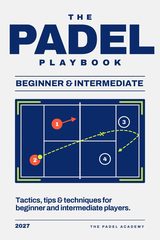
Calling is a habit, so practise it where mistakes are cheap. Play a few drills where a missed or late call loses the point, even if the shot went in. The Padel Drill Book has partner and four-player drills you can score this way, and The Padel Playbook: Beginner & Intermediate shows the positions behind the calls with court diagrams. For the bigger tactical picture, read our padel doubles strategy guide, and if you are still looking for a regular teammate, see how to choose a padel partner.
Frequently asked questions
What do padel players say to each other during a point?
Mostly single words: "mine", "yours", "switch", "leave it", "up" and "back", plus where the opponents are. The calls aren't official, so agree yours before the match.
What do the hand signals behind the back mean in padel?
They are the net player's plan for the serve. In one common system, one finger means serve to the middle, two fingers serve wide, a fist means the net player stays and an open hand means they cross. Pairs agree their own.
Who should call the ball down the middle?
Whoever is taking it, as early as possible. Agree a default before the match, often the player whose forehand faces the middle, so a late call is rarely needed.
Is it OK to talk to my partner between points?
Yes, briefly. FIP rules allow up to 20 seconds between points, so one sentence of tactics or encouragement fits. Save longer discussions for the change of ends.
What if my partner speaks a different language?
Agree a few one-word calls in the warm-up, use hand signals for the serve and agree who takes the middle in advance. Many players use the Spanish mía and tuya because they are widely understood.