Padel workout over 40: a twice-a-week strength plan
After 40, the gym stops being optional extra fitness for padel and becomes the thing that keeps you on court. Two short strength sessions a week are enough to protect the calves, knees, back and shoulders that padel loads hardest, and to keep the quickness that age takes first.
This guide explains common patterns in plain language. It can't diagnose you. If the pain is severe, came from a fall or twist, or isn't settling, get it assessed.
Why strength matters more after 40
In a 2025 survey of 645 French padel players (Lecler and colleagues), players over 40 had about four times the odds of injury of younger players. Muscle changes are part of the story: a 2012 review (Mitchell and colleagues) found strength declines faster than muscle size with age, and Reid and Fielding (2012) describe muscle power, strength produced quickly, as declining earlier and more steeply than strength. Tendons stiffen less with age too, but in a 2018 review (McCrum and colleagues) 12 to 14 weeks of resistance training increased tendon stiffness in older adults by a similar amount to younger people. In short: you lose it faster, but you can still build it.
How much?
The NHS recommends strengthening activities that work all the major muscle groups on at least two days a week, alongside at least 150 minutes of moderate activity. The NSCA's position statement on resistance training for older adults (Fragala and colleagues, 2019) recommends two to three sessions a week, two to three sets per exercise, and including power training with fast lifting of moderate loads. It also notes that most training injuries happen to inexperienced people lifting heavy with poor technique, so start light.
The workout
| Session A | Session B |
|---|---|
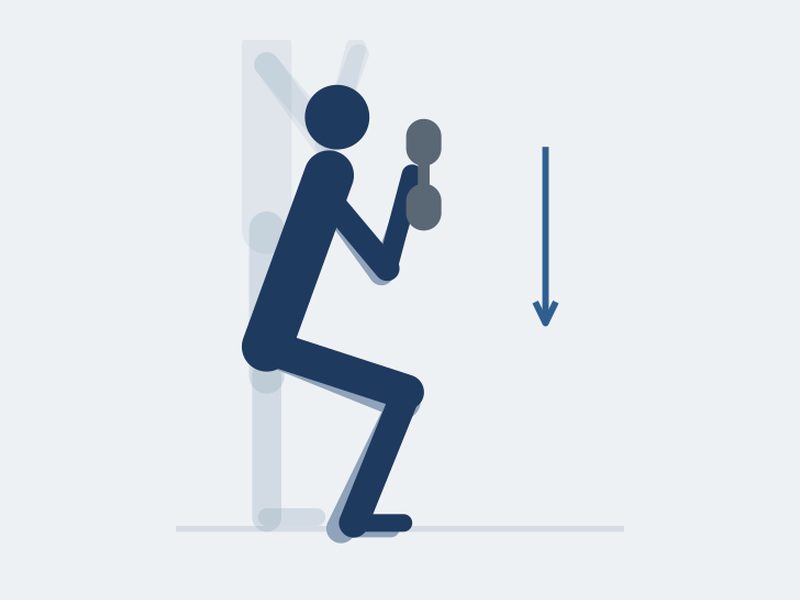
| Goblet squat 3 × 10 | Rear-foot-elevated split squat 3 × 8 each |
| Single-leg Romanian deadlift 3 × 8 each | Glute bridge 3 × 12 |
| Straight-knee calf raise 3 × 12–15 | Bent-knee calf raise 3 × 12–15 |
| Side plank 3 × 20–30 s each | Pallof press 3 × 10 each |
| Band external rotation 2 × 15 | Prone Y raise 2 × 10 |
| Finisher, from week 5: rotational medicine-ball throw 3 × 6 each side, fast | |
Pick a load you could lift two or three more times at the end of each set. Add weight when every set feels comfortable. The fast throw is the power work; keep it light and quick rather than heavy. Our workout builder turns this into a PDF with the "40+" dose for each exercise.
Fitting it around padel
- Keep at least a day between the leg-heavy session and a hard match.
- Two padel sessions plus two strength sessions is a good starting week.
- When time is short, do the calf raises and the side plank; they protect the most-injured areas.
Start slowly
Padel New Zealand describes load management as particularly relevant for older adults, new players and people coming back from a break. Start with one or two sets of each exercise for the first fortnight and add from there. Read padel injuries after 40 for the problems this plan targets.
Frequently asked questions
What is the best padel workout for over 40s?
Two short strength sessions a week covering squats or split squats, hip hinges, calf raises, side planks and shoulder band work, plus light power work.
How often should I strength train for padel after 40?
At least twice a week; the NHS recommends strengthening activities on two or more days, and the NSCA suggests two to three sessions for older adults.
Is it too late to get stronger at 40, 50 or 60?
No. Research shows older adults still respond to strength training, including tendons, which stiffen with training much as in younger people.
Should older padel players lift heavy?
Build up gradually. Most training injuries happen to inexperienced people lifting heavy with poor technique.
Why include power exercises after 40?
Power declines earlier and faster than strength with age, and padel depends on quick movements. Light, fast exercises help maintain it.
Sources
- Lecler et al. (2025): risk factors for padel injuries, a cross-sectional study of 645 French players (Journal de Traumatologie du Sport)
- Mitchell et al. (2012): sarcopenia, dynapenia and the impact of advancing age on muscle size and strength (Frontiers in Physiology)
- Reid and Fielding (2012): skeletal muscle power, a critical determinant of physical functioning in older adults (Exercise and Sport Sciences Reviews)
- McCrum et al. (2018): leg muscle-tendon properties with ageing and mechanical loading (Frontiers in Physiology)
- NHS: physical activity guidelines for adults aged 19 to 64
- Fragala et al. (2019): resistance training for older adults, NSCA position statement (Journal of Strength and Conditioning Research)
- Kravitz: summary of the NSCA position statement on resistance training for older adults (University of New Mexico)
- Padel New Zealand: injury prevention in padel