Jumper's knee from padel: patellar tendinopathy explained
If the spot that hurts is just below your kneecap, it aches at the start of a match, eases once you're warm and then grumbles the next morning, the most likely culprit is the patellar tendon. It's called patellar tendinopathy or jumper's knee, and padel feeds it with jumping smashes, hard braking and lots of split steps. The good news: it usually responds well to the right kind of loading, not to complete rest.
This guide explains common patterns in plain language. It can't diagnose you. If the pain is severe, came from a fall or twist, or isn't settling, get it assessed.
What jumper's knee is
The patellar tendon runs from the bottom of your kneecap to the top of your shinbone. Every time you land, brake or push off, it stores and releases energy like a spring. When that load rises faster than the tendon can adapt, it becomes painful and less tolerant of load. The NHS describes this kind of tendon pain as sitting between the kneecap and the shin and often coming from repetitive running or jumping.
Mayo Clinic lists the typical risk factors: running and jumping sports, a sharp increase in how often or how hard you train, tight thigh muscles and muscle imbalances. The Aspetar review of padel injuries adds that patellar tendinopathy is about two to four times more common in men than in women.
How it feels: the typical pattern
- Location: a small, specific spot just below the kneecap, usually easy to point to with one finger.
- Timing: Mayo Clinic notes pain often appears at the start of activity or after a hard session. Many players find it eases once warm, then comes back later.
- Triggers: jumping, landing, deep squats, stairs (especially going down) and sitting for a long time with the knee bent.
- No locking or giving way: those point to something else, such as the meniscus, and need assessing.
Pain that is more of a dull ache around or behind the kneecap, worse on stairs and standing up from a chair, is more typical of patellofemoral (front-of-knee) pain. Our main padel knee pain guide has a symptom table to help you tell them apart.
Why padel is a classic trigger
Padel adds load to this tendon in short, sharp bursts: the split step before every return, the brake after sprinting to a drop shot, the jump on a smash or por tres, and the deep knee bend to dig a ball out of the back glass. A weekend Americano on top of your usual matches is the textbook story: a big jump in volume in a few days, and the tendon complains.
Treatment: load it, don't just rest it
Tendons respond to load. The widely used protocol from Malliaras and colleagues (2015, summarised by Physiopedia) progresses through four stages:
| Stage | What you do | Move on when |
|---|---|---|
| 1. Isometric holds | Hold a static knee extension or wall sit: 5 holds of 45 seconds, 2 to 3 times a day, building effort as pain allows | Pain during exercise is only minimal |
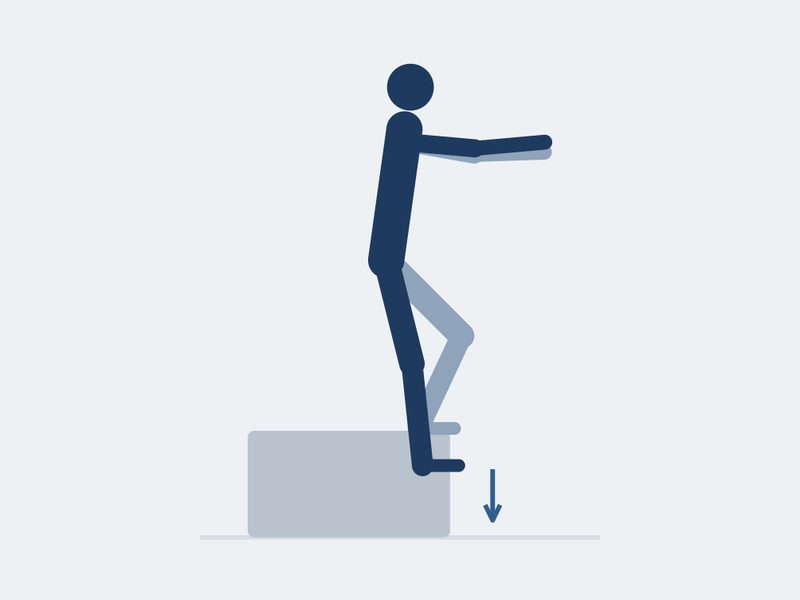
| 2. Slow strength | Leg press, split squats, step-downs: 3 to 4 sets, starting around a 15-rep load and building towards a 6-rep load, every second day | Strength is close to your other leg and the knee tolerates it |
| 3. Spring loading | Hops, skips, landings, then jumps, building volume first and intensity second | Pain on load tests is back to baseline within 24 hours |
| 4. Back to padel | Drills first, then match play, then competition | You tolerate full training |
Two things make this work: patience (tendons adapt over weeks and months, not days) and honest pain monitoring, which is the next section.
Can you keep playing?
Often, yes, with limits. A 2021 pilot trial on patellar tendinopathy (Sprague and colleagues) tested pain-guided activity modification, and that approach is widely used: activity is acceptable if pain stays at a moderate level during and right after it (up to about 5 out of 10) and has settled back to its usual level by the next morning. If the knee is worse the next day, the previous session was too much.
Practical padel changes while you rebuild: fewer jumping smashes (a bandeja or a flat smash without a jump costs less), shorter sessions, no back-to-back days, and skip the Americano for a few weeks. Our article can I play padel with knee pain? walks through the decision.
When to see someone
See a GP or physio if the pain isn't improving within a few weeks, or straight away if the pain is sudden and severe. The NHS says to get urgent advice if:
- your knee is very painful
- you can't move it or put any weight on it
- it is badly swollen or has changed shape
- it locks, gives way or clicks painfully (painless clicking is normal)
- you have a very high temperature, or feel hot, cold or shivery, with redness or heat around the knee
Frequently asked questions
Is jumper's knee the same as patellar tendinitis?
Yes, they are names for the same problem. Patellar tendinopathy is the term most clinicians now use, because it is mainly a problem of the tendon's load tolerance rather than inflammation.
How long does jumper's knee take to heal?
It varies a lot. Tendons adapt slowly, so a structured loading programme usually takes weeks to months. Rushing back to full jumping is the most common reason it lingers.
Should I stop playing padel completely?
Not necessarily. Many people keep playing at reduced volume as long as pain stays moderate during play and settles by the next morning. If it gets worse day to day, cut back further.
Does a patellar strap help?
Some players find a strap below the kneecap makes play more comfortable in the short term. It doesn't treat the cause, so use it alongside a loading programme.
Why is it worse at the start of a match?
A sensitive tendon often hurts when it is first loaded and settles as you warm up. That is why a proper warm-up matters, and why pain that builds during play is a sign to stop.
Sources
- NHS: knee pain
- Mayo Clinic: patellar tendinitis
- Eirale and de Gasperis (2023): Injuries in padel, Aspetar Sports Medicine Journal
- Physiopedia: patellar tendinopathy (loading protocol after Malliaras et al. 2015, Sports Medicine)
- Sprague et al. (2021): pain-guided activity modification for patellar tendinopathy, pilot RCT (Pilot and Feasibility Studies)