Padel reaction drills
The best padel reaction drills don't just make you move faster: they train you to read the hitter earlier, keep your preparation compact and decide late. Below are nine drills, from two-feeder reflex volleys and balls at the body to poaching and reading the back glass, each with a court diagram, a pass mark and a progression.
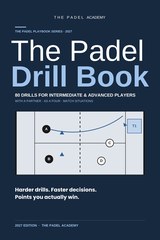
All the drills below are adapted from The Padel Drill Book: Intermediate & Advanced. We have reworded and shortened them for the web; the book has the full versions, with a court diagram for every drill.
How to get fast hands at the net
Quick reactions in padel are less about raw speed and more about being ready earlier. Three things make the difference, and every drill here trains at least one of them.
- The split step. A small hop timed so you land just as your opponent hits. The Padel School puts it simply: without it you react late; with it you can move in any direction straight away.
- The racket in front of you. The Padel School describes the ready position with the racket upright in front of your body; LTA Padel advises holding it at about the height you'll hit, above the net. Both agree on the point: you shouldn't lose time lifting or bringing the racket round.
- A block, not a swing. At the net, both sources describe a short racket path with contact in front of the body. A big swing is the main reason reflex volleys arrive late.
A fourth habit is reading. Watch the hitter's racket rather than your own last shot, and you'll start moving before the ball has crossed the net. Our volley guide covers the technique in detail.
Safety: Keep reflex feeds below shoulder height, start at moderate pace and build up. Nobody feeds while the volleyer is turned away.
Padel reaction drills at the net: reflex volleys
1. Two-feeder reflex (N6 in the book)
Players: 3 · Time: 10 min · Level: 4–6
Set-up: You're at net position, slightly right of centre. Two feeders, each with balls: one at the far net, cross-court from you, the other on the far service line straight ahead. A deep target zone sits between them.
How it works: The feeders take turns. The second feed leaves as your first volley crosses the net, so there's no time to admire your shot. Every volley goes into the deep zone, away from both of them. Twenty balls per set, thirty seconds' rest, three sets, then rotate. For set three they change the pattern: one of them may feed twice in a row.
The key idea: The moment your volley leaves the racket, your eyes go to the next feeder. Split as their racket starts forward.
Pass mark: 16 of 20 volleys land in the zone in the third set.
Make it harder: The feeders speed up and aim at your body as well as wide.
2. Body-ball defence (N7 in the book)
Players: 2 · Time: 10 min · Level: 4–6
Set-up: You're at the net, two to three metres back. A feeder on the far service line drives firm balls at your body, always below the shoulder. Mark a deep zone.
How it works: The feeds go to your right hip, left hip and chest in random order, starting moderate and getting quicker. In the book's version, chest and left-hip balls are played on the backhand, with the racket head in front and the elbow sliding out of the way; only clear right-hip balls go to the forehand. Block with no swing, so the ball goes down at the feeder's feet or deep into the zone. In set two, the feeder punishes any loose block with another drive and you play it out.
Pass mark: In set two, 11 of 15 blocks go down or deep.
Make it harder: The feeder steps a metre nearer and hits harder, or slips in a sudden lob over your head.
Watch for: Leaning back, which sends the ball upwards. Stay forward on your feet and meet the ball ahead of you.
3. Volley clock (N1 in the book)
Players: 2 · Time: 12 min · Level: 3–5
Set-up: You're at net position on the drive side. The feeder is two metres or so inside the opposite service line. Four numbered cones mark targets, two deep and two short.
How it works: Feeds come at medium pace, hip to chest high, and the feeder calls a number on contact. Split, listen and volley to that cone: firmer for the deep ones, softer and angled for the short ones. Recover to your start spot after each ball. In set two the call comes when the ball is halfway; in set three, as it crosses the net.
Pass mark: 14 of 20 volleys reach the called cone in the third set.
Make it harder: More pace, plus a fifth call, "middle", for the gap between the cones.
Watch for: A bigger swing for the deep targets. Keep one compact shape and change only the angle of the racket face and how firmly you hold it.
4. Dig and close (N3 in the book)
Players: 2 · Time: 12 min · Level: 3–5
Set-up: You begin a step inside the service line on the drive side. From the far net the feeder sends two balls, one straight after the other. A deep zone is marked next to the far back glass.
How it works: Ball one is slow and dipping, at your feet. Bend your knees, open the racket face slightly and lift it deep into the zone. As it travels, close in with a few fast steps and split when the feeder prepares. Ball two comes higher, around chest height; volley it down into the open court. Ten pairs per set, three sets.
Pass mark: 7 of 10 sequences with the dig in the zone and the finishing volley into open court.
Make it harder: The second feed follows the moment your dig is over the net, and is sometimes low as well.
Reaction drills for reading the opponent
5. Poach and cover (N10 in the book)
Players: 4 · Time: 15 min · Level: 5–6
Set-up: Your pair at the net, the opponents at the back. Each rally opens with one of them driving cross-court at your partner on the right.
How it works: If the drive crosses the net through the middle third, you (on the left) move diagonally forward, call "mine" and intercept, aiming at the far player's feet or the gap between them. Your partner crosses behind you straight away to cover the side you've left. Play the point out. If you don't poach, your partner volleys as normal. Swap sides after ten points.
The key read: Only poach a ball you can reach in front of you and volley downwards. Go halfway and you end up with both of you on one side.
Pass mark: Win 6 of 10 poaching points and lose none down the side you vacated.
Make it harder: The opponent may disguise the drive and send it down the line, which punishes a poach that leaves too early.
6. Poach the return (S6 in the book)
Players: 4 · Time: 15 min · Level: 5–6
Set-up: Your partner serves from the right; you're at the net on the left. Before each serve you give a hand signal behind your back: poach or stay.
How it works: On "poach", your partner serves to the centre or the body, and you move across as the receiver's racket starts forward, not before, and volley firmly at the other net player's feet or through the middle. After serving, your partner heads for the side you've left in case the return goes down the line. The receiver doesn't see the signal, so they must choose a return every time.
Pass mark: Win 6 of 10 poach points, with the server covering the open side on every one.
Make it harder: Add a fake: start a step across, then recover.
7. Late-call overhead (O9 in the book)
Players: 2 · Time: 15 min · Level: 4–6
Set-up: You're at net position on the right. A feeder lobs from the far baseline. Three zones: deep middle (bandeja), cross-court corner (víbora) and open court (smash).
How it works: Once you've turned and your preparation is complete, the feeder calls one word: bandeja, víbora or smash. Play the called shot into its zone and recover to the net. Do three sets of nine. In the final set, the call is left until just before you swing forward.
Why it helps: One neutral preparation that can become any of three overheads also makes you harder to read. Our bandeja guide covers the base shot.
Pass mark: 20 of 27 calls played as the right shot into the right zone.
Make it harder: The feeder may also call "leave": turn, let the ball go by and play it once it comes off the back glass.
Reaction drills off the glass
8. Call the drop (G1 in the book)
Players: 2 · Time: 12 min · Level: 3–5
Set-up: You start on the service line, drive side. A feeder stands two to three metres from the net on the far side. Cones stand at 1, 2 and 3 metres from your back glass.
How it works: Turn sideways as soon as the ball crosses the net. Before it reaches the glass, call "one", "two" or "three": the cone where, after the rebound, it will have dropped to hip height. Move there, let it come down and play a controlled ball cross-court. The feeder confirms each call; a missing call counts as wrong. After twelve balls, change to the revés side.
Pass mark: 9 correct calls and 9 clean returns out of 12 on each side.
Make it harder: The feeder adds side spin and the occasional ball into the corner off two walls, so the angle of the rebound changes as well as its length.
9. The ball that dies (G8 in the book)
Players: 2 · Time: 12 min · Level: 3–5
Set-up: You're at the back on the drive side. Sliced feeds come from the opposite service line. Set out two zones: one deep and cross-court, one short, just beyond the net.
How it works: The sliced feeds skid into the glass and come off low, often below the knee. Bend early with your knees, not your back, and get the racket under the ball. From knee height or above, lob deep cross-court; lower than that, play a soft, safe ball into the short zone. The feeder mixes sliced and plain feeds without warning.
Pass mark: 7 of 10 balls back over the net, at least 4 of them in the deep zone.
Make it harder: Some sliced feeds are aimed at the corner, where two walls take even more height out of the ball.
Watch for: Waiting at your usual spot. Slice makes the ball come off shorter and lower, so get nearer the wall and stay low. The back glass guide explains why.
These 9 drills are adapted from The Padel Drill Book: Intermediate & Advanced. The book has 80 drills, each with its own court diagram, plus two ready-made sessions at the end of every chapter and three eight-week plans for levels 3 to 6. See the book and look inside the first 20 pages.
A 60-minute reaction session
- 0–8 min: warm-up. Easy volley exchanges at the net, then a few split steps in time with your partner's contact.
- 8–20 min: Volley clock. Three sets, with the call coming later each time.
- 20–30 min: Two-feeder reflex. Three sets of twenty, rotating roles.
- 30–40 min: Body-ball defence. One set at moderate pace, one live.
- 40–48 min: Call the drop. One round on each side.
- 48–60 min: Poach and cover. Ten points each way. If you want to work on the serving pair instead, use Poach the return.
Common mistakes in reaction training
- Watching your own shot. Turn your head to the next hitter as soon as the ball leaves your racket.
- Splitting at the wrong moment. Land as the opponent hits. Too early and you're flat-footed; too late and you're still in the air.
- Swinging at fast balls. A short block in front of the body is quicker and more accurate.
- Guessing instead of reading. In the poaching drills, leaving before the hitter commits lets them change direction.
- Feeding too fast too soon. Raise the pace only when the pass mark comes easily.
For more net work, see our padel volley drills.
Frequently asked questions
How can I improve my reaction time in padel?
Time your split step to the opponent's contact, keep the racket in front of you, use a short block instead of a swing, and practise reading the hitter. Drills with late calls or two feeders, like Volley clock and Two-feeder reflex, train all of these at once.
How do you get faster hands at the net?
Shorten the stroke. Most slow hands are really big swings. Hold the racket in front of the body, meet the ball in front of you and block it, then practise against faster feeds once your control holds.
What is a split step in padel?
A small hop, timed so you land as your opponent strikes the ball. You come down balanced and light, ready to push off in any direction.
Can you do padel reflex drills alone?
Not these ones: they need at least one feeder. On your own, wall work and footwork exercises help; see our solo padel drills.
Are reflex drills at the net safe?
Yes, if the feeder keeps balls below shoulder height, starts at moderate pace and never feeds while the volleyer is turned away. Increase the pace gradually.