Padel volley drills
The best padel volley drills make you choose as well as hit: deep or short, block or punch, your ball or your partner's. The ten drills below cover target volleys, low balls at your feet, balls at your body, the angled finish, poaching and moving as a pair, each with a court diagram, a pass mark and a harder version.
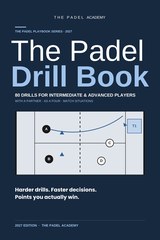
These drills are adapted from The Padel Drill Book: Intermediate & Advanced: nine from its net chapter and one from the serve chapter. The code after each name is its number in the book.
How to practise volleys so they work in a match
Many points are won or lost at the net, yet a lot of players practise volleys only by trading soft balls with a partner. That builds feel, which is useful, yet it never asks the question a match asks: what should this volley do? Each drill here gives you that question.
- Technique first. Use a continental grip, keep the backswing short and meet the ball out in front. LTA Padel and The Padel School both teach the volley as a compact block or push rather than a swing. Our padel volley guide covers the basics.
- Start about two metres from the net, racket up in front of you, so you can step in to the ball and still cover the lob.
- Split step on the hit. Land a small hop just as the feeder or opponent strikes the ball.
- Read the height. If you meet the ball above the net tape you can hit down. Below it, send it deep and reset the rally.
Padel volley drills: targets and pace
1. Volley clock (N1 in the book)
Players: 2 · Time: 12 min · Level: 3–5
Set-up: You are at the net on the right. Your feeder, with a basket, stands a little inside the far service line. Place four numbered cones on the far side, two deep and two short.
How it works: The feeder sends medium-paced balls to your forehand and backhand and shouts a number as each one is struck. Split, listen and volley to that cone: a firmer block for the deep ones, a softer, angled touch for the short ones. Reset after every ball. Over three sets the call gets later: on the feed, then halfway, then as the ball crosses the net.
Pass mark: Fourteen of twenty on target in the late-call set.
Make it harder: Feed faster, and add a fifth call, "middle", meaning the space between the cones.
2. Two-speed volley (N2)
Players: 3 · Time: 12 min · Level: 3–5
Set-up: You are at the net on the right. The feeder drives from the far back court so the ball arrives with pace. C stands cross-court on the far service line. Mark a deep target box behind C.
How it works: The feeder mixes two heights: below the tape, or between waist and shoulder. On a low ball, open the face slightly and block it deep, using the pace that is already on it. On a high ball, step in and angle it downwards into C's feet, leaving C only an upward reply. If C gets it back, play one more volley. Fifteen feeds, then rotate.
Pass mark: Twelve of fifteen with the pace matched to the height of the ball.
Make it harder: Add fast balls at chest height, which also have to be blocked deep.
3. Dig and close (N3)
Players: 2 · Time: 12 min · Level: 3–5
Set-up: You start just inside the service line on the right. The feeder stands at the far net position with two balls ready. Mark a deep target near the far back glass.
How it works: The first feed is slow and dipping at your feet. Bend your knees, keep the stroke short and lift it deep into the target. While it travels, close in with a few fast steps and split as the feeder prepares. The second ball comes higher, so volley it down into the open court. If your dig lands short, stay where you are and defend instead of moving in.
Pass mark: Seven of ten sequences with a deep dig and a finished second ball.
Make it harder: The second ball comes as soon as your dig crosses the net.
4. Finish into the side wall (N4)
Players: 3 · Time: 12 min · Level: 4–6
Set-up: You are at the net on the right. The feeder works from the far back court, and C defends diagonally from the far baseline. Mark a short target against the side wall, near the net.
How it works: Most feeds arrive at waist height and you send them deep. Every third or fourth is high and slow. Turn your shoulders, meet it well in front and angle it short cross-court so it bounces in the target and then runs into the side. Floor first, wall second: a volley that hits their side wall before bouncing loses the point (FIP Rule 13). If C reaches it, play on. After fifteen balls, your partner works the backhand angle from the left.
Pass mark: Seven of a final ten high balls bounce in the target and beat C.
Make it harder: C starts on the service line, so the angle has to be sharper.
Padel volley exercises for the pair
5. Split the pair (N5)
Players: 4 · Time: 14 min · Level: 3–5
Set-up: You and your partner hold the net against C and D at the back. Mark a two-metre channel down the middle of their half. C starts every rally with a drive.
How it works: Play the point out, with the defenders free to drive, lob or go low. Aim as many volleys as you can into the channel, ideally deep enough to reach the glass between them. A middle ball that both defenders leave, or both go for, scores two. Everything else scores one. Play to eleven, then swap roles.
Pass mark: Take the game, with one volley in three or better landing in the channel.
Make it harder: The defenders stand closer together, so you have to choose between the middle and the side glass.
6. Body-ball defence (N7)
Players: 2 · Time: 10 min · Level: 4–6
Set-up: You are at the net, two to three metres back. The feeder stands on the far service line and drives firmly at your body, always below shoulder height. Mark a deep target.
How it works: The feeder aims at your right hip, left hip or chest in a random order, building pace through the set. For the chest and left hip, use the backhand: racket head in front, elbow moving out of the way. Only an obvious right-hip ball is a forehand. Don't swing. Block it down at the feeder's feet or deep, never up. In the second set the feeder hits again after any loose block and the exchange is live.
Pass mark: In the second set, eleven of fifteen body balls end up low or deep.
Make it harder: The feeder moves a metre closer or slips in a sudden lob.
7. Six deep, then strike (N8)
Players: 4 · Time: 14 min · Level: 3–5
Set-up: Your pair holds the net against C and D at the back. The last three metres of their half is the deep zone. C starts with a drive.
How it works: Count every ball your pair plays, out loud. Your first six shots, volleys or bandejas, have to reach the deep zone. Anything short, or any attacking shot before number seven, costs you the point. From seven on, finish anything that sits up. The defenders score two for a point won before you reach seven. Depth is not the same as slowness, so drive each volley through to their glass.
Pass mark: Reach seven in at least half the rallies and win the game to eleven.
Make it harder: Raise the count to eight and let the defenders attack any short ball.
8. Slide as one wall (N9)
Players: 3 · Time: 12 min · Level: 3–5
Set-up: You and your partner at the net. The feeder moves between five spots across the far back court with a basket.
How it works: The feeder steps to a spot and shows the ball. You slide as a pair: whoever is facing the ball guards the line, the other shades the middle. Then comes a drive, and the player responsible volleys it deep. Keep the gap between you constant. Whoever moves, both move the same distance.
Pass mark: Eighteen times in twenty, both of you are in the right place before the feed.
Make it harder: The feeder stops showing the ball first and may lob. Our doubles positioning guide explains the shape.
9. Poach and cover (N10)
Players: 4 · Time: 15 min · Level: 5–6
Set-up: Your pair holds the net; C and D are at the back. C opens every rally with a cross-court drive towards you.
How it works: If the drive comes through the middle third, your partner moves diagonally forward, calls "mine" and intercepts at D's feet or into the middle. On that call you cross straight away to cover the side your partner left. Play the point out. Only poach a ball you can take in front and hit down. A half-hearted poach leaves you both on one side. Swap roles after ten points.
Pass mark: Six wins from ten poach points, and no point lost through the side left open.
Make it harder: C can disguise the drive and switch it down the line.
10. Serve, split, volley deep (S2)
Players: 3–4 · Time: 12 min · Level: 3–5
Set-up: You serve from the right box while your partner covers the net on the left. C returns from close to the far back glass.
How it works: Serve deep and legally (see our serve and return guide), then move forward towards the middle of the right half. Split as C's racket starts forward, wherever you are. This first volley usually happens near the service line, well short of the net. Send it into the last three metres, cross-court or through the middle, then play the point out.
Pass mark: Seven first volleys in ten land in the deep zone.
Make it harder: Add D at the net; your first volley must stay away from D.
A 60-minute padel volley session
- 0–10 min: warm-up. Easy volley-to-volley rallies with a partner, then split steps on every ball.
- 10–22 min: Volley clock. Three sets, with the call getting later each time.
- 22–34 min: Two-speed volley. Rotate every fifteen feeds so everyone volleys.
- 34–44 min: Dig and close. Two sets of ten sequences each.
- 44–60 min: Six deep, then strike. Games to eleven, swapping ends between games.
With four players and more experience, replace Dig and close with Poach and cover.
Common volley mistakes these drills fix
- A big swing. A full backswing makes you late. Keep the racket in front and let the incoming ball supply the pace.
- Punching balls below the tape. They go into the net or sit up. Below the tape, lift deep.
- Watching your own volley. Recover and split for the next ball instead.
- Standing too close to the net. You get lobbed and lose the room to step in.
- Moving alone. At the net the pair moves together, or the middle opens.
These 10 drills are adapted from The Padel Drill Book: Intermediate & Advanced. The book has 80 drills, each with its own court diagram, plus sixteen ready-made sessions and three 8-week training plans. See the book and look inside the first 20 pages.
Frequently asked questions
What are the best padel volley drills?
Drills that make you choose the volley, not just hit it: a called target, a different answer for high and low balls, and live games where the depth of your volleys decides the point. Volley clock and Two-speed volley are good places to start.
How do I practise volleys without a coach?
Take turns as the feeder with a basket of balls, agree a pass mark before each drill and write down your score. Every drill on this page can be run by players themselves.
How far from the net should I stand to volley in padel?
About two metres is a good starting point. It is close enough to put pressure on the opponents and far enough back to step into the ball and still cover a lob.
Should I volley deep or at the opponents' feet?
It depends on the height of the ball. From below the net tape, play deep. From above it, or against a player moving forward, you can hit down at the feet.
Can I practise padel volleys alone?
Yes, against a solid wall you can work on a short, firm volley. Our solo padel drills include wall exercises.